
13 Best Pendo Alternatives & Competitors in 2026 (With Real Pricing Data)
This is a comparison of 13 Pendo alternatives, including budget options, direct replacements, pure analytics tools, and enterprise digital adoption platforms. Each tool gets a short summary covering pricing, strengths, and limitations. Plus a section on when Pendo is still the right pick.
In this post
- Why people look for Pendo alternatives
- What Pendo does well
- How Pendo’s pricing actually works
- The alternatives
- How to choose between them
- Summary
- FAQ
Why people look for Pendo alternatives
Opaque pricing. Pendo doesn’t publish prices on their pricing page. Every paid plan requires going through a sales call. Per Vendr data covering ~300 reported deals, annual spend ranges from roughly $18K to $148K, with a median around $48K. Community reports also cite three-year mandatory commitments and 5-20% annual price increases at renewal.
Slow setup and learning curve. Reviewers on G2 describe Pendo’s setup as more like configuring a CRM than a plug-and-play platform. Implementation timelines of weeks to months are commonly cited.
In-app guides need CSS. A frequent G2 complaint: Pendo’s Guides feature is hard to make look polished without CSS customization. For non-technical teams, this turns a no-code tool into one that still needs engineering resources.
Feature gating and hidden add-ons. Several capabilities most teams expect to be included are sold as add-ons or locked behind higher tiers. Common examples cited on G2 and in community discussions: unbranded NPS surveys, webhooks, and session replay. Quotes for entry-level plans often expand significantly once add-ons are included.
What Pendo does well
Deep product analytics. Pendo’s core strength. Funnels, retention cohorts, user paths, behavioral segments, and session replay are all native to the platform. Recent AI additions include natural-language queries on your product data and MCP integration with Claude or Cursor.
Native mobile support. Pendo offers native iOS and Android SDKs. While some alternatives do, the lineup that does is limited.
Bundled product roadmapping. Pendo Roadmaps is included in the platform, letting product teams sync their roadmap with usage data and customer feedback in one place. Most alternatives in this list don’t offer roadmapping at all.
Free tier exists. The free plan covers up to 500 MAU with basic in-app guides, NPS surveys, and product analytics. Useful for early-stage teams to validate Pendo’s value before committing.
How Pendo’s pricing actually works
The full mechanics are sales-gated, but the structure is publicly known.
Pricing is modular and MAU-scaled, with no public numbers. Pendo sells modules separately (Analytics, Guides, Session Replay, Sentiment, Listen, Orchestrate, Roadmaps), plus add-ons for features like unbranded NPS, webhooks, and session replay that aren’t bundled. Your quote depends on which modules and add-ons you select, plus your MAU count. The pricing page lists no dollar amounts.
Reported spend by tier. Per Vendr data:
- Free: up to 500 MAUs. Basic analytics and in-app guides.
- Starter: 500-2,000 MAUs. Roughly $7K-$12K annually.
- Growth: 2K-10K MAUs. Roughly $20K-$60K+ annually.
- Portfolio: Enterprise or multi-product. Roughly $75K-$200K+ annually.
Annual contracts are standard. List pricing isn’t usually the final price: 15-30% off list is achievable through negotiation, especially with longer terms or higher MAU volumes. Multi-year deals (3-year common) get steeper discounts but lock in 5-20% renewal increases.
Free tier locks at the cap. Up to 500 MAU. Once you exceed it, guide creation, survey creation, and segment creation lock, and reports start sampling from 500 users randomly. Try-before-you-buy, not a sustainable free option in the long run.
The alternatives
Simpler, cheaper alternative
1. FlowNavi
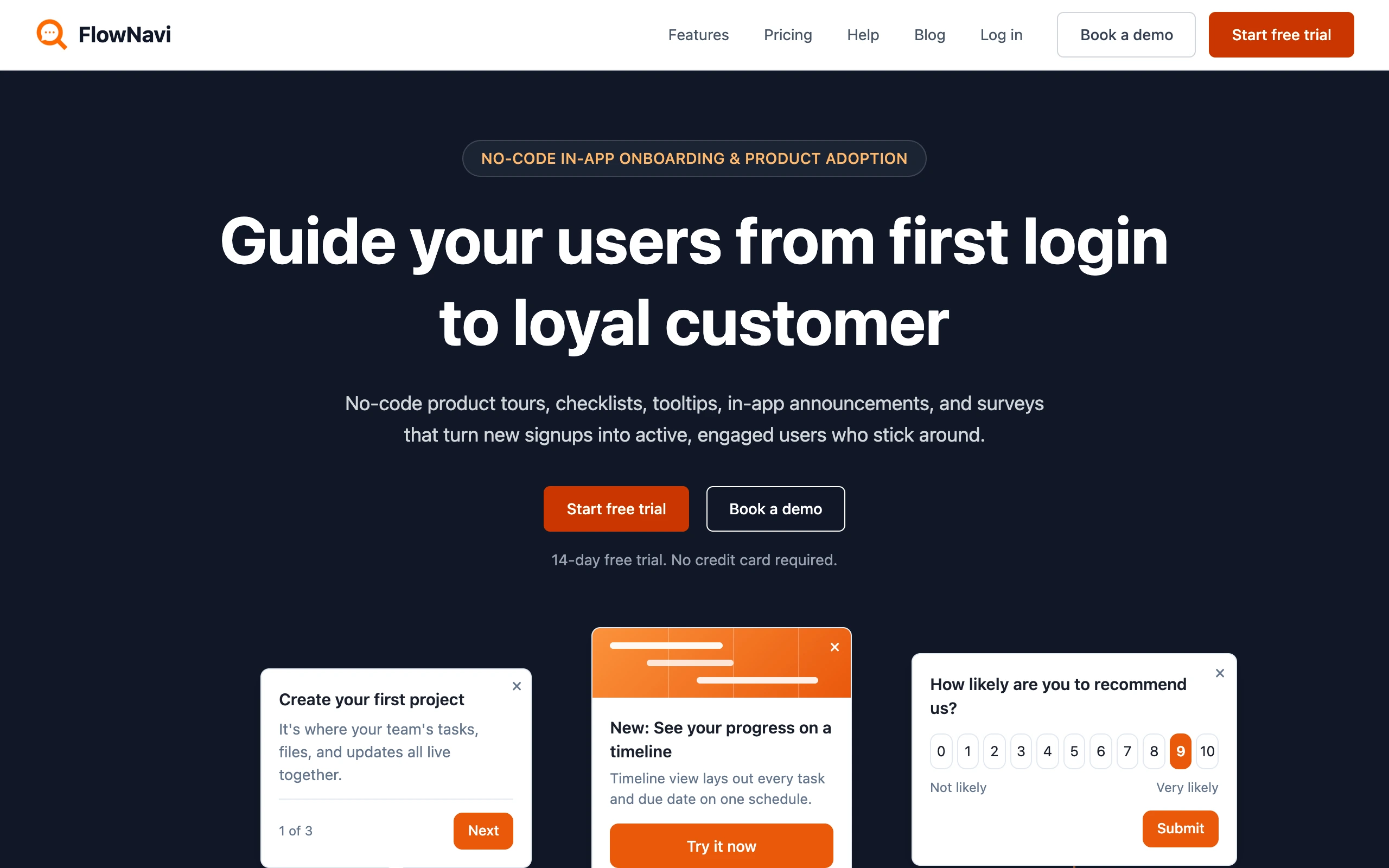
FlowNavi is a no-code tool for in-app onboarding and product adoption: product tours, checklists, tooltips, hotspots, in-app announcements, and NPS and custom surveys. If the in-app guides are the part of Pendo you actually care about, FlowNavi is a simpler, cheaper way to get them.
Pricing. From $79/month. Free trial available.
What it does well. It’s a fraction of Pendo’s cost, and everything it does is included on every plan, so there are no modules or add-ons to buy on top. Setup is no-code, and most teams have their first guides live within a day or two. There’s also an Enterprise plan for teams that have security and compliance requirements.
Where it falls short. FlowNavi doesn’t do what Pendo is best known for: there’s no product analytics (no funnels, retention cohorts, or session replay), no mobile SDKs, and no roadmapping. If those are why you’re considering Pendo, FlowNavi won’t replace them.
Best for. Teams that evaluated Pendo, decided its analytics and modules are more than they need, and want no-code in-app onboarding and adoption guides at a low price.
Disclosure: FlowNavi is our product, so we’re not a neutral source here. We’ve tried to give Pendo a fair shake and be upfront about what FlowNavi can’t do.
All-in-one mid-market platforms
2. UserGuiding
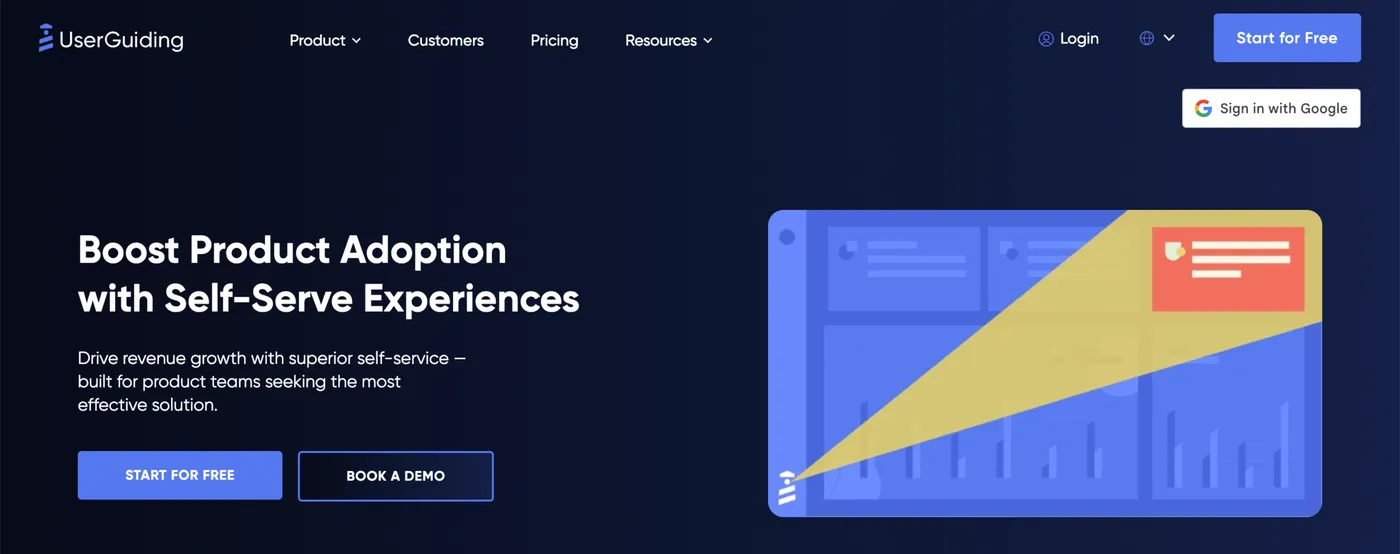
UserGuiding is a no-code product adoption platform focused on in-app guidance and content: tours, checklists, hotspots, surveys, a knowledge base, and an AI assistant. It overlaps with the in-app guides part of Pendo, not Pendo’s analytics, mobile, or roadmapping.
Pricing. From $174/month. Free trial available.
What it does well. All-in-one for in-app guidance at a way lower price point than Pendo. The Starter plan includes tours, hotspots, checklists, NPS, a knowledge base, an AI assistant, product updates, and resource centers (most with caps: 25 guides, 20 hotspots, 2 checklists, 5 surveys). Most of these are usually sold as separate tools at this tier. Authoring runs through a no-code Chrome extension on top of your live product.
Where it falls short. Analytics are shallower than Pendo’s. Starter includes engagement analytics, segmentation, and custom events, but funnel analysis, goal tracking, A/B testing, and impact reports require the Growth plan. Session replay also requires Growth. No native mobile (web only, unlike Pendo). No roadmapping module. No multi-channel workflows. Custom CSS, localization beyond 4 languages, and premium integrations (Salesforce, HubSpot) also gated behind the Growth plan ($349/month).
Best for. SMB and mid-market SaaS teams who only need the in-app guidance side of what Pendo offers, not the analytics, mobile, or roadmapping. If your fit matches that scope, the price difference is dramatic.
Want a closer look? Read our full post on UserGuiding alternatives.
3. Userpilot
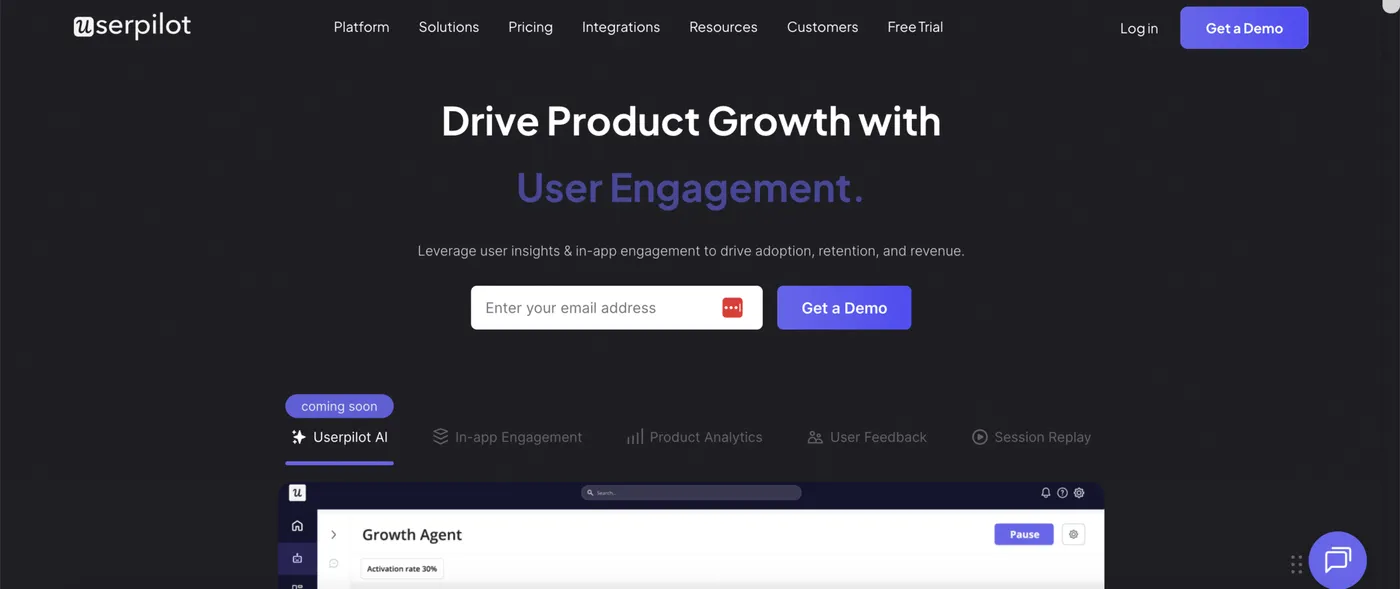
Userpilot is a product growth platform that bundles in-app guidance with native analytics. Probably the closest direct Pendo alternative on bundle scope, at a published price tier instead of Pendo’s sales-gated quotes.
Pricing. From $299/month. Free trial available.
What it does well. Bundle scope close to Pendo’s: flows (tours), checklists, NPS, and basic engagement on Starter; funnel analysis, retention cohorts, autocapture, and behavior-triggered email on Growth. Session replay is available as a Growth-tier add-on. Starter pricing is published, which is the main thing Pendo evaluators come looking for (Growth and Enterprise are still custom-quoted).
Where it falls short. Native mobile is a paid add-on, not included in any tier. Annual billing only. Doesn’t include Pendo Roadmaps or Pendo’s deeper data science layer.
Best for. Mid-market teams that want Pendo’s in-app guidance + analytics combo at a transparent published price, and don’t need roadmapping or Pendo’s full module range.
Want a closer look? Read our full post on Userpilot alternatives.
4. Appcues
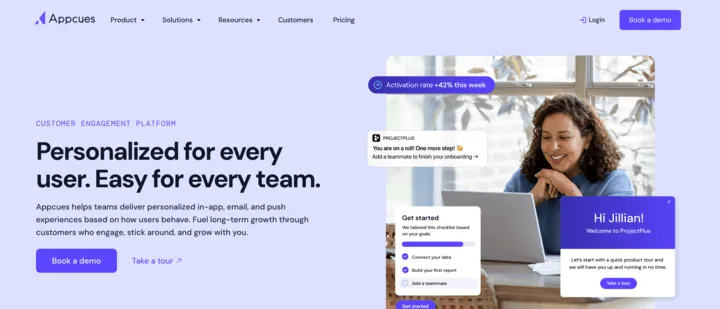
Appcues is one of the longer-running in-app engagement platforms, around since 2013. Per their pricing page, every plan includes the full platform: every experience type, every channel (in-app, behavioral email, push notifications), every integration. Tiers differ only by MAU count and number of published experiences, not by feature gating.
Pricing. Custom. Per Vendr data, real customer spend ranges from roughly $5.7K to $44K per year.
What it does well. Purpose-built for in-app engagement, where Pendo started as analytics and added engagement on top. The “every plan includes everything” model is a meaningful contrast to Pendo’s modular pricing (where Analytics, Guides, Session Replay, and Roadmaps are sold as separate modules). Multi-channel delivery covers in-app messages, behavioral email, and push notifications, with workflows that branch based on user behavior.
Where it falls short. Analytics are basic compared to Pendo. Teams that need deep analytics and robust analytics dashboards today will still want a dedicated product analytics tool like Amplitude or Mixpanel alongside Appcues. Custom pricing only. Vendr’s range ($5.7K-$44K) overlaps with Pendo’s Starter ($7K-$12K) and Growth ($20K-$60K) tiers, so Appcues isn’t necessarily a lot cheaper at any given MAU level.
Best for. Teams that want a single platform for multi-channel in-app engagement without paying separately for each capability. Best paired with a separate analytics tool, since Appcues doesn’t replace Pendo’s analytics depth.
Want a closer look? Read our full post on Appcues alternatives.
5. Chameleon
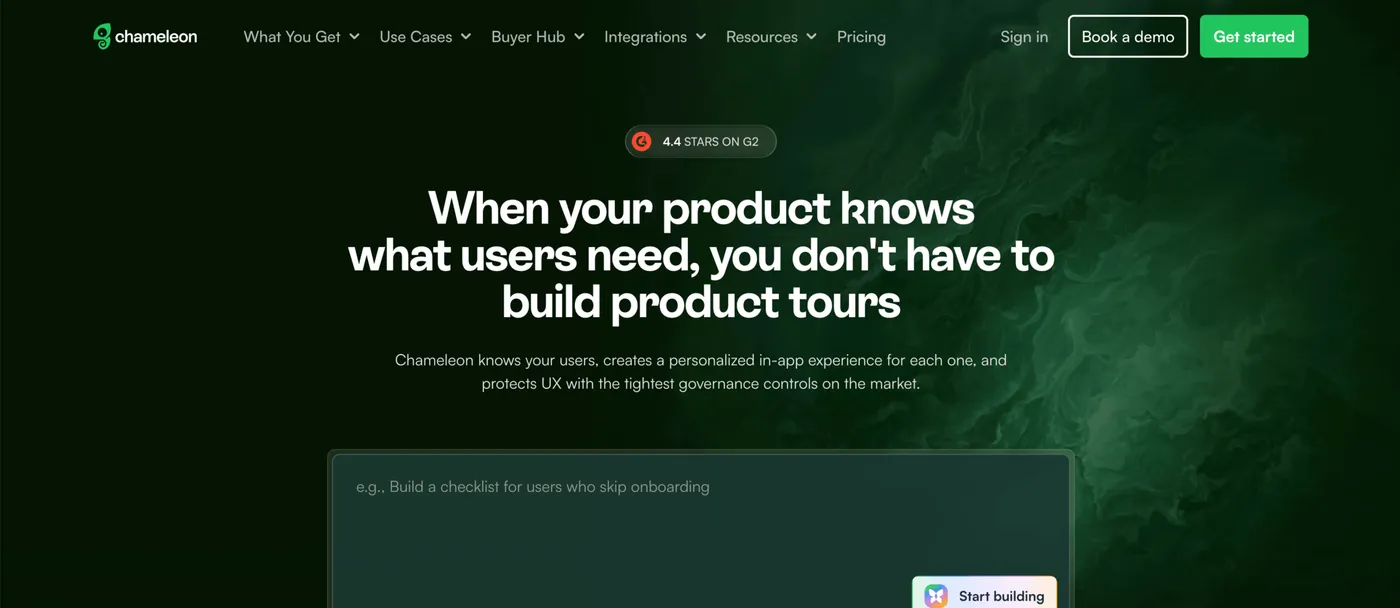
Chameleon is a product adoption platform focused on in-app guidance: tours, tooltips, launchers, surveys, and an AI Copilot. Charges by Monthly Tracked Users (MTUs, unique users who interact with your product each month) rather than total active users.
Pricing. From $279/month. Free trial available.
What it does well. Customization and design fidelity. Custom CSS is included on the Startup plan, letting experiences look native to your product. The AI Copilot plans and builds in-app campaigns based on user behavior. Per Vendr data, Chameleon is typically 30-50% less expensive than Pendo (median customer pays $26,500/year vs Pendo’s ~$48K median).
Where it falls short. Lacks Pendo’s deeper product analytics. No session replay. No roadmapping module. A/B testing is gated to the Growth plan, not Startup.
Best for. SaaS teams that want native-feeling in-app guidance and don’t need Pendo’s analytics, session replay, or roadmapping.
Pure product analytics
6. Heap
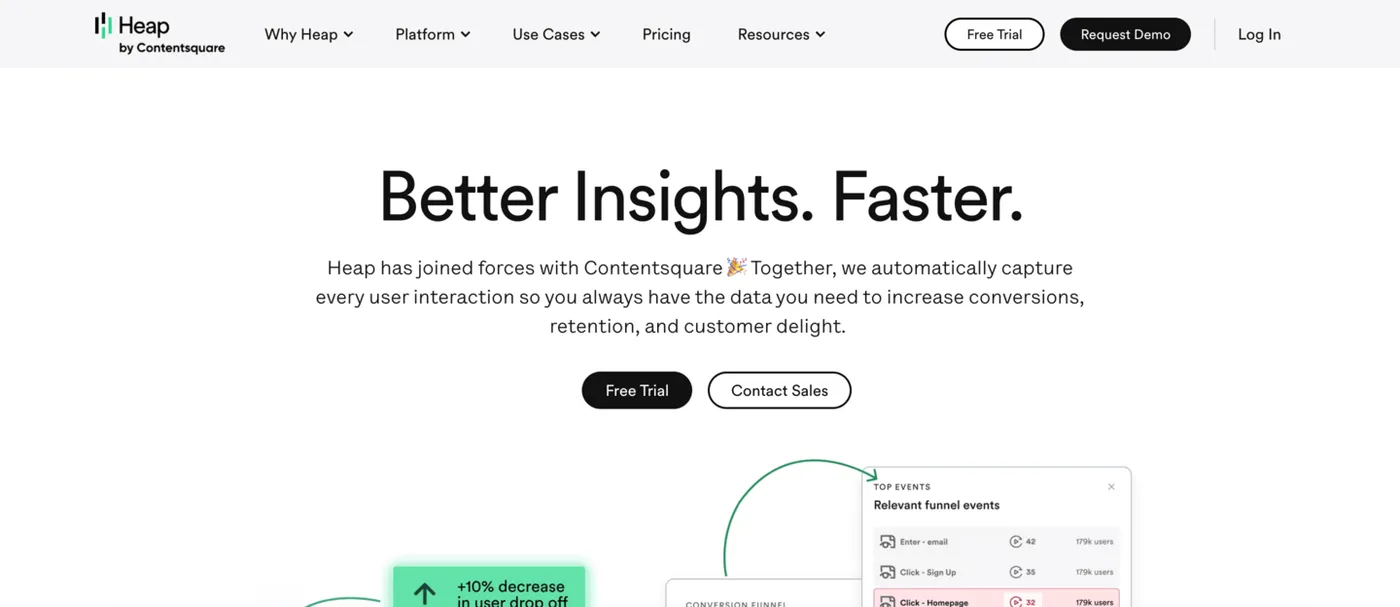
Heap is a pure product analytics tool. Its main differentiator is autocapture: instead of asking developers to instrument every event you want to track, Heap records every user action automatically. Heap charges by sessions (visits to your product) rather than monthly active users like Pendo, which changes cost economics for high-engagement products.
Pricing. Free tier (up to 10K monthly sessions). Paid plans are custom; per Vendr data, median customer pays $39,000/year, with a range from $13,000 to $124,000.
What it does well. Funnels, retention, journeys, and segmentation are included on every tier (including free). The autocapture model means you can answer questions about user behavior that you didn’t think to track when you set up the tool, including questions that come up months later.
Where it falls short. No in-app guidance, no tours, no surveys, no roadmapping. Heap is analytics only; you’ll need a separate tool (like Appcues, Userpilot, or Chameleon) for everything Pendo bundles around analytics. Session replay and heatmaps are paid add-ons on Pro and Premier tiers, not included by default.
Best for. Pendo evaluators who care about deep analytics and are either don’t need in-app guidance or fine pairing Heap with a separate in-app guidance tool.
7. Amplitude
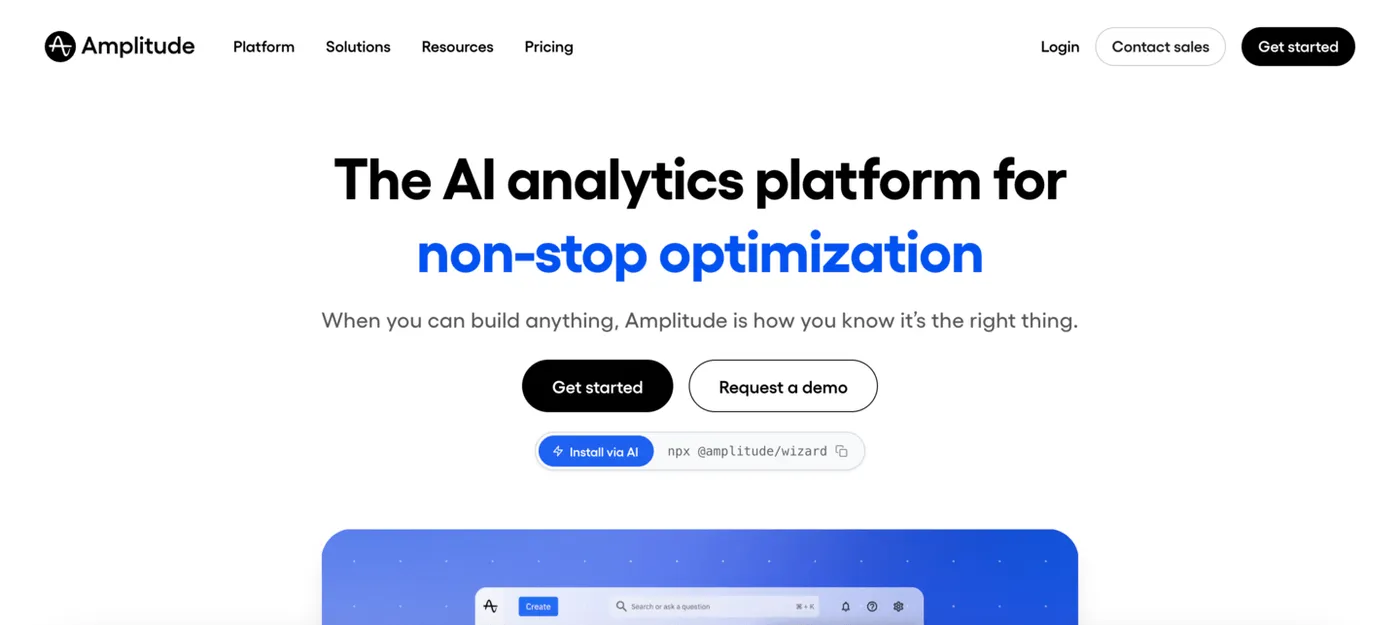
Amplitude started as a product analytics tool but has expanded into a broader platform including session replay, web and feature experimentation, in-app guides, and surveys. Charges by Monthly Tracked Users (MTUs), the same model Pendo uses, so direct cost comparisons are meaningful.
Pricing. Free tier (up to 10K MTUs). Plus from $49/month for higher volumes, billed annually. Growth and Enterprise are custom; per Vendr data, median customer pays $65,448/year, with a range from $24,775 to $379,933.
What it does well. Deep analytics with behavioral cohorts, retention analysis, conversion drivers, and predictive audiences. The free tier includes session replay and unlimited feature flags, which is generous compared to most analytics tools. Self-serve pricing calculator on the Plus plan makes costs predictable up to 300K MTUs.
Where it falls short. In-app guides are much lighter than Pendo’s (Plus includes only 1 Guide/Survey, more are add-ons). No roadmapping module. Vendr median ($65K) is higher than Pendo’s median ($48K), and the upper range ($382K) is among the highest in this comparison.
Best for. Pendo evaluators who care most about analytics and experimentation depth. Particularly good for teams that want everything Pendo does on the analytics side, plus session replay and A/B testing, and can either get by with Amplitude’s lighter in-app guidance or pair it with a separate tool.
8. Mixpanel
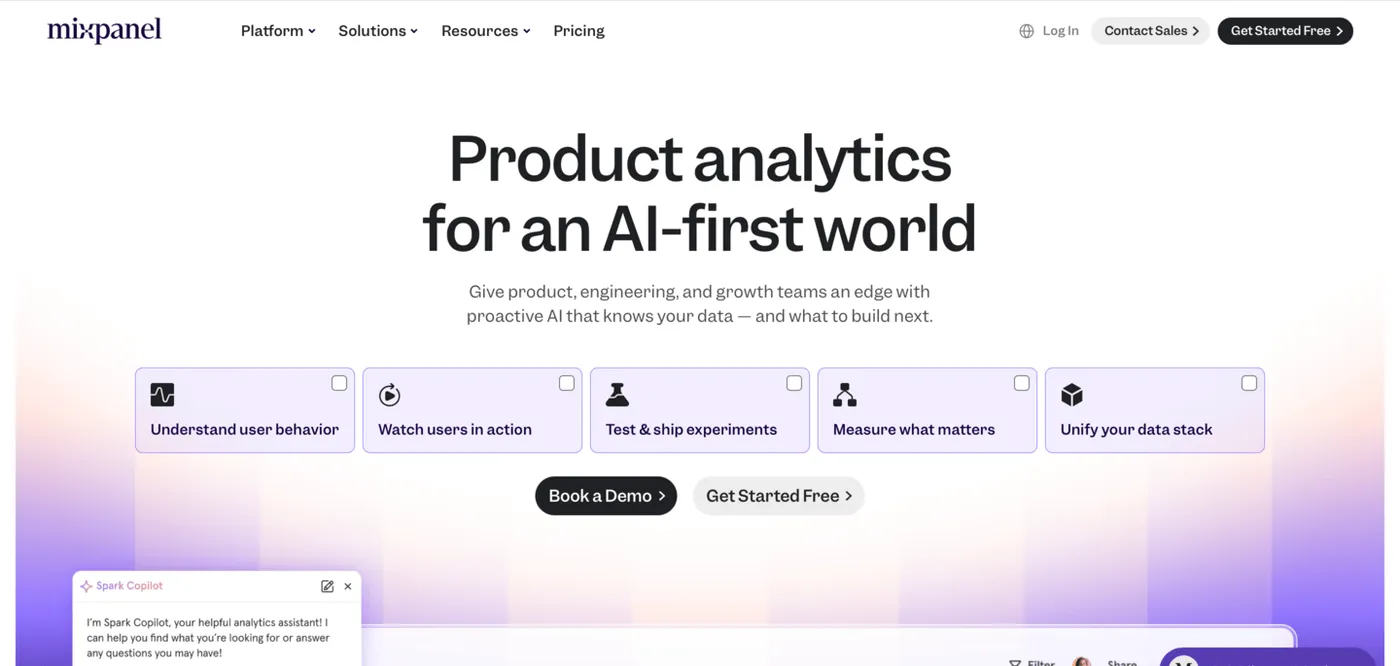
Mixpanel is a pure product analytics tool. Unlike Amplitude (which has expanded into guides and surveys), Mixpanel stays focused on analytics: funnels, retention, behavioral cohorts, session replay, experiments, and metric trees. No in-app guides, no surveys, no roadmapping.
Pricing. Free tier (1M events/month). Growth starts at $0 and charges $0.28 per 1,000 events after the first 1M, with volume discounts. Enterprise is custom; per Vendr data, median customer pays $38,194/year, with a range from $13,500 to $99,055.
What it does well. Generous free tier (1M events covers most early-stage products). Event-based pricing is different from Pendo’s MAU-based pricing: a low-engagement product with many users may be cheaper on Mixpanel; a high-engagement product with fewer users may be more expensive. Session replay is included on every tier, with 10K-20K replays per month free. AI query builder is bundled.
Where it falls short. No in-app guidance, no tours, no checklists, no surveys, no roadmapping. Mixpanel is analytics only; you’ll need a separate tool (Appcues, Userpilot, Chameleon, etc.) for everything Pendo bundles around analytics. Feature flags and A/B testing are add-ons on Growth (included in Enterprise).
Best for. Pendo evaluators who want pure analytics and have or are willing to add a separate in-app guidance tool. Particularly good for teams with low-engagement products (where event volume is moderate) and for early-stage teams who can stay on the free tier.
9. PostHog
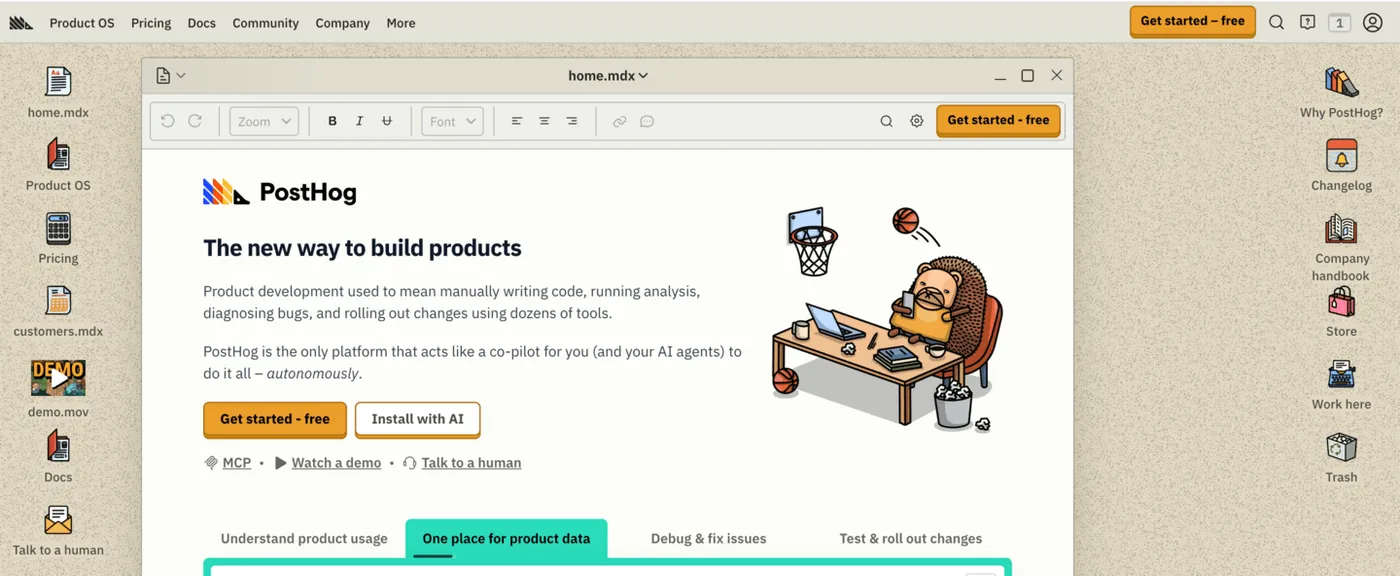
PostHog is an open-source product analytics platform with a generous free tier and usage-based pricing. The platform bundles product analytics, session replay, feature flags, experiments (A/B testing), surveys, data warehouse, error tracking, and more, but doesn’t include in-app guides or onboarding flows.
Pricing. Free tier with monthly limits (1M analytics events, 5K session replays, 1M feature flag requests, 1.5K survey responses). Pay-as-you-go after that, per product. Per their pricing page, “more than 90% of companies use PostHog for free.”
What it does well. Generous free tier and per-product usage-based pricing means you only pay for what you use, with no minimums or annual commitments. Self-hosting available via the MIT-licensed open-source version (notable if you have data residency requirements or want to avoid vendor lock-in). Bundles experiments, feature flags, and session replay alongside analytics, which Pendo charges separately for or doesn’t include.
Where it falls short. No in-app guides, tours, checklists, or roadmapping. PostHog is analytics + experiments + surveys, not in-app guidance; you’ll need a separate tool (Appcues, Userpilot, Chameleon, etc.) for what Pendo bundles around analytics. Self-hosting requires engineering effort to set up and maintain.
Best for. Pendo evaluators who want a usage-based, transparent-pricing alternative for analytics, experiments, and surveys, and either don’t need in-app guides or are willing to add a separate tool. Particularly good for engineering-led teams or teams with data residency requirements that benefit from open-source self-hosting.
Enterprise digital adoption
10. WalkMe
WalkMe is an enterprise digital adoption platform focused on overlaying in-app guidance on top of internal business applications like Salesforce, Workday, ServiceNow, and SAP.
Pricing. Custom. Per Vendr data, median customer pays $40,290/year, with a range from $14,360 to $199,771. Pricing is per user per month, typically $12-$35 depending on tier.
What it does well. Built for complex enterprise deployments across many internal applications. Standard tier covers in-app guidance, tooltips, and task automation. Enterprise tier adds multi-application support, A/B testing, role-based segmentation, and advanced integrations. ActionBot (AI chatbot) and WalkMe Insights (analytics) are available as add-ons.
Where it falls short. Different category from Pendo: WalkMe is built for employee-facing internal app adoption (Salesforce, Workday), not customer-facing product onboarding. Implementation is heavyweight: content creation requires significant internal effort or paid services. Sales-led pricing only, with custom quotes for everything. Add-ons commonly add 15-40% to base contracts.
Best for. Enterprise teams whose primary use case is internal employee adoption of multiple business applications, particularly if they use SAP. If your use case is customer-facing product onboarding, Pendo’s bundle is a closer fit.
11. Whatfix
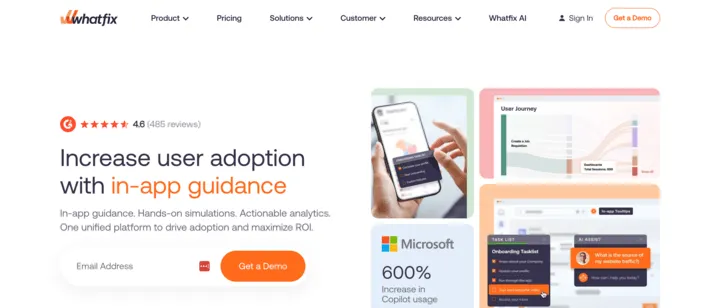
Whatfix is an enterprise digital adoption platform that competes most directly with WalkMe. The product line includes three distinct products: DAP (Digital Adoption Platform) for in-app guidance, Product Analytics, and a sandbox training environment with AI-powered roleplay scenarios for hands-on user training.
Pricing. Custom. Per Vendr data, median customer pays $31,950/year, with a range from $25,390 to $38,766. Per Whatfix’s FAQ, pricing is a flat fee plus user license fees: total employees for internal apps, MAUs for customer-facing apps. No prices published on Whatfix’s own page.
What it does well. Three distinct products under one vendor. DAP covers in-app guidance, self-help widgets, and analytics. Product Analytics Standard is included free with any DAP plan. The training environment is a relatively unique offering: it captures real applications as sandbox training environments, with AI roleplay scenarios and SCORM export for learning management systems. Vendr’s pricing range is much tighter than WalkMe’s ($25K-$39K vs $14K-$200K), suggesting more predictable budgeting.
Where it falls short. Same category mismatch as WalkMe: Whatfix is primarily for employee-facing internal app adoption, not customer-facing product onboarding. No published pricing, all sales-led. The training environment is a separate product that adds to total cost on top of DAP. Add-ons like 24/7 Support, On-Premise Authoring, and dedicated success management can also expand the contract.
Best for. Enterprise teams whose primary use case is internal employee adoption of business applications, particularly if hands-on training simulations are important. Like WalkMe, this is a closer fit for SAP/Salesforce/Workday rollouts than for SaaS product onboarding.
12. Userlane
Userlane is an enterprise digital adoption platform with a single all-inclusive plan structure (no Standard/Premium/Enterprise tiers). Pricing is custom-quoted based on users, applications, and rollout scope. Distinctive features: HEART analytics, their framework for measuring digital adoption progress, paired with App Discovery for cataloging which SaaS apps employees actually use.
Pricing. Custom. No prices published on Userlane’s site, and Vendr does not display median or range data for Userlane.
What it does well. All features included on every plan: in-app guides, tooltips, announcements, custom audience analytics, HEART analytics, App Discovery, support channel integration, multi-language. EU-based with regional data residency in Germany, Netherlands, or US, useful for European buyers with strict data location requirements.
Where it falls short. Same category as WalkMe and Whatfix: built for employee-facing internal app adoption (Salesforce, Workday, SAP), not customer-facing product onboarding. Pricing is sales-led with no published rates.
Best for. European enterprise teams that need EU data residency, and want a simpler all-features-included pricing structure than WalkMe’s tier system. Like WalkMe and Whatfix, fit for internal app adoption rather than customer-facing SaaS product onboarding.
13. Apty
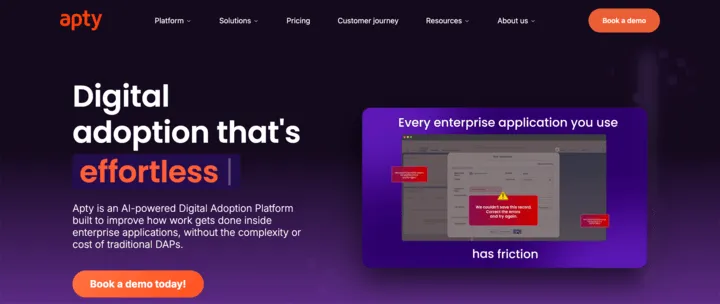
Apty is an enterprise digital adoption platform with a distinctive ROI guarantee: per their site, Apty refunds your investment if it doesn’t deliver 2x ROI in year one. The platform combines AI-powered in-app guidance with analytics that track how employees actually use software like Salesforce, Workday, ServiceNow, Microsoft Dynamics, Coupa, and Infor.
Pricing. Custom. Apty doesn’t publish pricing on their site, and Vendr doesn’t display median or range data for Apty.
What it does well. The ROI guarantee is the standout in this list (WalkMe, Whatfix, and Userlane don’t offer the same commitment). Their analytics give you visibility into which apps employees are using, where they’re getting stuck, and which features are going unused.
Where it falls short. Same category as WalkMe and Whatfix: built for employee-facing internal app adoption, not customer-facing product onboarding. No published pricing, all sales-led.
Best for. Enterprise teams (Apty markets to Fortune 1000) that want an ROI commitment on their digital adoption investment, particularly for rolling out CRMs, ERPs, or HR systems. Like WalkMe, Whatfix, and Userlane, this is a fit for internal app adoption rather than SaaS product onboarding.
How to choose between them
A quick way to narrow down based on what’s pulling you toward alternatives.
By priority:
- Similar bundle scope as Pendo, lower price: UserGuiding, Userpilot, Appcues, Chameleon
- Pure analytics (drop the in-app guidance): Heap, Amplitude, Mixpanel, PostHog
- Multi-channel messaging (in-app + email + push): Appcues, Userpilot
- Internal employee adoption of business apps (Salesforce, Workday, SAP): WalkMe, Whatfix, Userlane, Apty
- Cheaper, simpler in-app guides, no analytics: FlowNavi
Two things worth watching for:
Pure analytics tools don’t replace Pendo’s in-app guidance. If you switch from Pendo to Heap, Amplitude, Mixpanel, or PostHog, you’ll need a separate tool (Appcues, Userpilot, Chameleon, FlowNavi) for in-app guides, tooltips, and onboarding flows. Budget for both.
Enterprise DAPs are a different category. WalkMe, Whatfix, Userlane, and Apty are built for helping employees use internal business software, not for onboarding new users to your SaaS product. If your use case is customer-facing product onboarding, Pendo, Appcues, Userpilot, or UserGuiding are closer fits.
Summary
| Tool | Target | Starting price | Key strength |
|---|---|---|---|
| Pendo | Mid-market to Enterprise | Free + Custom | Bundled analytics, guides, mobile, roadmaps |
| FlowNavi | SMB SaaS | $79/mo | Low-cost in-app guides, no analytics bundle |
| UserGuiding | SMB SaaS | $174/mo | All-in-one bundle (tours + KB + AI) at a low price |
| Userpilot | Mid-market SaaS | $299/mo | Closest direct Pendo alternative on bundle scope |
| Appcues | Mid-market SaaS | Custom | Multi-channel + native mobile |
| Chameleon | Mid-market SaaS | $279/mo | Customization, less expensive than Pendo |
| Heap | All sizes | Free + Custom | Autocapture: every user action recorded automatically |
| Amplitude | All sizes | $49/mo | Deep analytics + experimentation, expanded into guides |
| Mixpanel | All sizes | Free + Custom | Pure analytics, generous free tier (1M events) |
| PostHog | All sizes | Free + Usage | Open source, all-in-one analytics + experiments + surveys |
| WalkMe | Enterprise | Custom | DAP for SAP, complex multi-app rollouts |
| Whatfix | Enterprise | Custom | DAP with hands-on training simulations |
| Userlane | Enterprise | Custom | EU-based, all-features-included pricing |
| Apty | Enterprise | Custom | DAP with 2x ROI guarantee |
FAQ
How much does Pendo really cost?
Per Vendr data, Pendo pricing breaks down roughly into four tiers: Free (up to 500 MAUs), Starter ($7K-$12K/year for 500-2,000 MAUs), Growth ($20K-$60K+/year for 2K-10K MAUs), and Portfolio ($75K-$200K+/year for enterprise scale). Median customer pays around $48,500/year. Annual contracts are standard, with 15-30% discounts achievable through negotiation, especially with multi-year commitments.
Is there a free Pendo alternative?
Several tools in this list have real free tiers. PostHog is the most generous, with 1M analytics events, 5K session replays, 1M feature flag requests, and 1.5K survey responses per month. Mixpanel includes 1M events free. Heap covers 10K monthly sessions free. Amplitude includes 10K MTUs free. For in-app guidance specifically (the Pendo Guides side), UserGuiding’s free tier covers a knowledge base and AI assistant only, no tours.
Pendo vs WalkMe: which one wins?
Different use cases, not really competing for the same buyer. Pendo is built for customer-facing SaaS product onboarding paired with product analytics. WalkMe is built for helping employees use internal business applications like Salesforce, Workday, ServiceNow, and SAP. If you’re a SaaS company onboarding new users to your product, Pendo is the closer fit. If you’re rolling out CRMs, ERPs, or HR systems to thousands of employees, WalkMe (now part of SAP) is the closer fit.
Can you replace Pendo with separate analytics and onboarding tools?
Yes. A common alternative stack is one analytics tool (Heap, Amplitude, Mixpanel, or PostHog) plus one in-app guidance tool (Appcues, Userpilot, Chameleon, or UserGuiding). Combined cost can be lower than Pendo’s bundled price, especially at smaller scale. Trade-offs: two vendor relationships, integration work between the two tools, and no shared data layer for cross-tool insights.
What features are sold as add-ons in Pendo?
Pendo splits its product into separately-priced pieces (Analytics, Guides, Session Replay, Sentiment, Listen, Orchestrate, and Roadmaps) that you mix and match. You buy only the pieces you need, but the quote depends on which combination you select. On top of that, some features that buyers expect to be included are commonly cited as extras: unbranded NPS surveys, webhooks, and certain session replay capabilities.