
11 Best Userpilot Alternatives & Competitors in 2026 (for product teams)
This is a comparison of 11 alternatives, spanning simpler low-cost tools, platforms in Userpilot’s class, and heavier analytics and enterprise options. Each one gets a short, honest summary of pricing, strengths, and limitations, plus a note on when Userpilot is still the right pick.
In this post
- Why people look for Userpilot alternatives
- What Userpilot does well
- How Userpilot’s pricing actually works
- The alternatives
- Simpler, more affordable alternatives: FlowNavi, Product Fruits
- Mid-market platforms similar to Userpilot: UserGuiding, Appcues, Chameleon, Userflow, Jimo, Intercom Product Tours
- Analytics-heavy and enterprise platforms: Pendo, WalkMe, Whatfix
- How to choose between them
- Summary
- FAQ
Why people look for Userpilot alternatives
Userpilot is well-rated by the people who use it, 4.6 out of 5 across 57 reviews on Capterra. But a handful of themes come up often enough to send teams looking at other options.
The entry plan is limited, and the step up is a sales call. Userpilot’s Starter plan starts at $299/month billed annually and caps you at 2,000 monthly active users. Funnels, retention, and paths analytics aren’t included at that tier, and neither are surveys beyond NPS or A/B testing. To get any of that you move to Growth or Enterprise, and neither plan has a public price.
Analytics depth is a recurring complaint. Even reviewers who like the product say the analytics fall short. One Capterra reviewer put it plainly: “Regarding analytics features, Userpilot isn’t the best.” Another wanted analytics that “bring more insights of what is a good result and what is a bad result.”
Performance can suffer on complex flows. Multiple Capterra reviewers describe bugs and slowdowns on larger projects: the interface freezing so “you have to redo your work,” bugs “when building more complex tours,” and the builder hanging, with one reviewer noting it “eats up the RAM too.”
There’s a learning curve. Several reviewers say it takes time to get comfortable, especially with advanced features. One described “a bit of a learning curve”; another noted that because the tool is powerful, “digging into it can take some time.”
Total cost adds up for smaller teams. Past the list price, Vendr puts the median Userpilot contract at $11,300 per year, with most buyers paying between $3,000 and $36,000 annually.
What Userpilot does well
To be fair, a list of weaknesses on its own isn’t useful. Userpilot does several things well.
It’s genuinely built for non-developers. No-code onboarding is the core pitch, and Capterra reviewers back it up. Product managers, founders, and marketers describe building and shipping flows themselves, with one noting that a flow they could build quickly would “take more than a week” if a developer had to do it.
It covers a lot of ground. The platform spans product analytics, in-app engagement (flows, spotlights, banners, checklists, resource centers), NPS and surveys, session replay, mobile, and email. If you want onboarding and product analytics from one vendor, that breadth is the appeal.
Support gets singled out repeatedly. Userpilot scores 4.7 for customer service on Capterra, and reviews regularly call out the team, including reviewers who say support jumped on calls to fix flows they couldn’t fix themselves.
It’s quick to get going. Reviewers describe building their first experience in under an hour and teams “building experiences on day one.”
How Userpilot’s pricing actually works
Userpilot publishes one price and quotes the rest. Here is the structure.
Three plans, scaling on monthly active users. There are three tiers: Starter, Growth, and Enterprise. Starter is the only one with a public price, from $299/month billed annually, for up to 2,000 monthly active users. It includes in-app engagement, segmentation (up to 10 segments), usage trends, and NPS, with 3 seats. Growth and Enterprise are quote-based, with no public price: Growth starts from 5,000 monthly active users and adds advanced analytics, event autocapture, resource centers, and email engagement, while Enterprise adds premium integrations, data warehouse sync, SAML SSO, custom roles and permissions, and a custom SLA.
Session replay and mobile are add-ons, even on paid plans. This matters if an all-in-one platform is the appeal: on both Growth and Enterprise, session replay and mobile engagement are listed as paid add-ons rather than included features.
What teams actually pay. Vendr, which tracks real contract data, puts the median Userpilot contract at $11,300 per year. Most buyers land between $3,000 and $36,000 annually: roughly $3,000 to $10,000 for small teams, $10,000 to $30,000 for mid-market, and $30,000 to $60,000 or more for enterprise deployments.
Budget for the extras. Per Vendr, Userpilot contracts often carry annual price escalation clauses in the 5 to 10 percent range, and implementation or professional services are quoted separately, commonly $2,000 to $10,000 or more.
The alternatives
Simpler, more affordable alternatives
1. FlowNavi
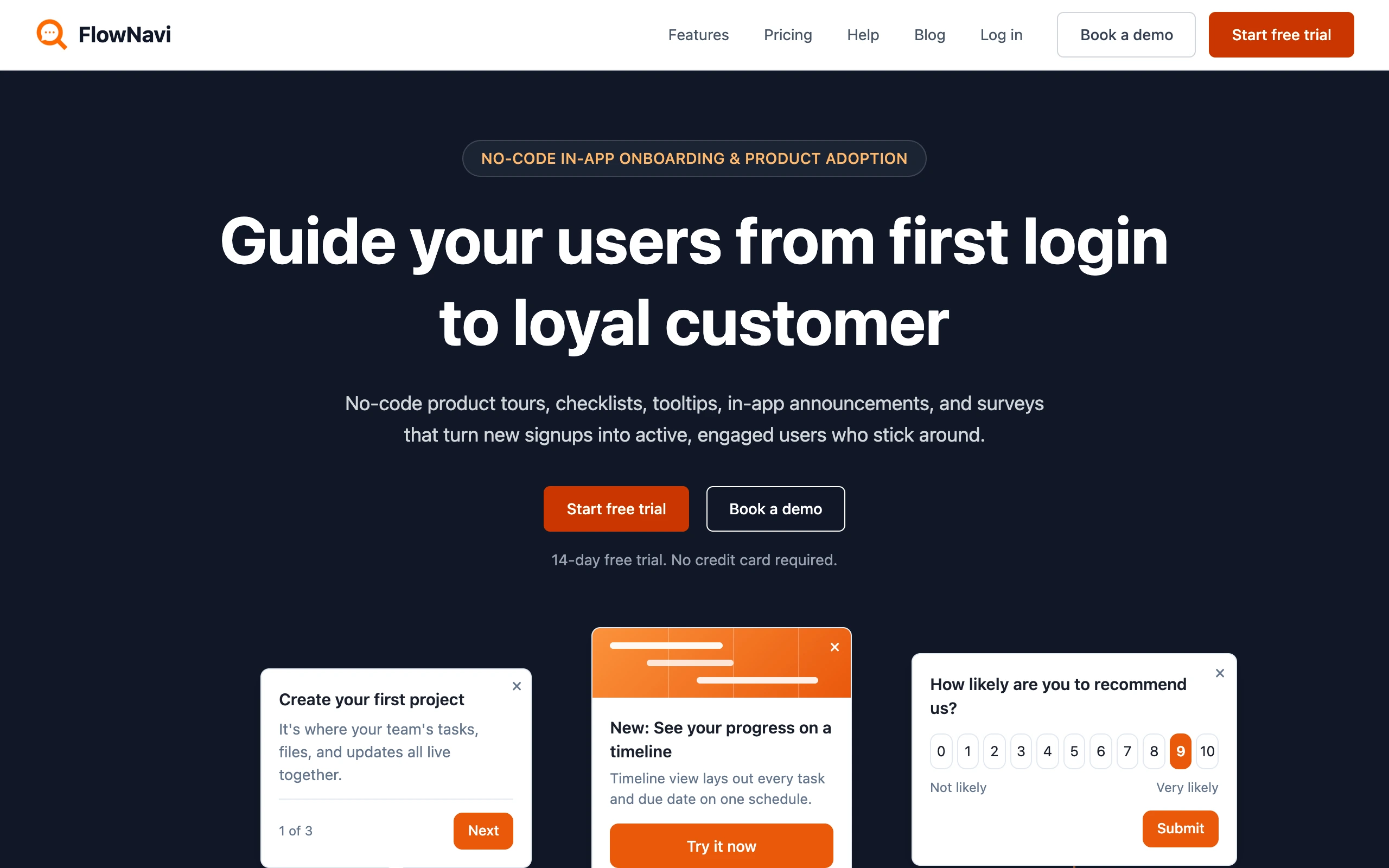
FlowNavi is a no-code tool for in-app onboarding and product adoption: product tours, checklists, tooltips, hotspots, in-app announcements, and NPS and custom surveys. It covers the in-app guidance side of what Userpilot does, at a lower price.
Pricing. From $79/month. Free trial available.
What it does well. The $79 plan includes FlowNavi’s full guide set, including custom surveys, where Userpilot keeps surveys for its higher tiers. Setup is genuinely no-code, so a small team can have guides live in a day or two.
Where it falls short. FlowNavi doesn’t do the analytics half of what Userpilot is built for. There’s no product analytics (no funnels, retention, or paths), no session replay, and no mobile SDKs. Its reporting stays on the guides themselves: completion rates, drop-off, and checklist progress. If you want onboarding and product analytics in one tool, Userpilot does more.
Best for. SMB and mid-market SaaS teams that want Userpilot’s in-app guidance at a lower price, and don’t need the product analytics, session replay, or mobile SDKs that come with the wider platform.
Disclosure: FlowNavi is our own tool, so we’re biased here. We’ve tried to keep this honest, including where FlowNavi falls short and Userpilot does more.
2. Product Fruits
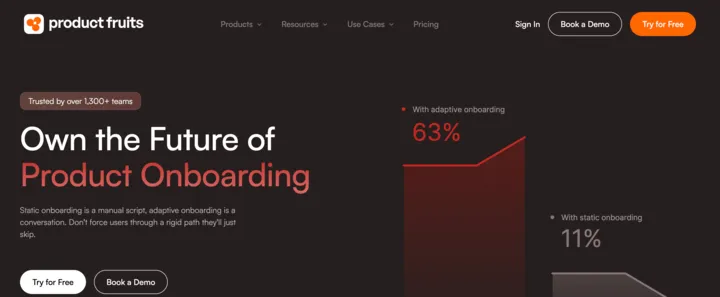
Product Fruits is a product adoption platform built around onboarding and in-app support, with a strong push on AI. Like Userpilot, it bundles a lot into one tool, but it leans toward the onboarding and self-serve support side rather than product analytics.
Pricing. From $111/month. Free trial available.
What it does well. Product Fruits covers a broad onboarding and support feature set: product tours, onboarding checklists, hints and tooltips, in-app announcements, NPS and surveys, a feedback widget, and a public and private knowledge base. Its AI layer answers users’ “how do I” questions from your knowledge base, launches on-demand guides, and can run conversational and voice onboarding. Pricing is also more transparent than Userpilot’s.
Where it falls short. Product Fruits is lighter than Userpilot on analytics. Its analytics are scoped to onboarding engagement, things like tour completion and where users drop off, while Userpilot offers full product analytics with funnels, retention, and paths. Userpilot also offers session replay, email engagement, and A/B testing, none of which Product Fruits lists. And the Starter plan has firm caps: 15 tours, 50 hints, 2 checklists, 3 seats, and one localization language, so growing teams move up tiers fairly quickly.
Best for. Teams that want a broad onboarding and in-app support toolkit, including a knowledge base and AI support agent, at a lower and more transparent price than Userpilot, and that don’t need deep product analytics, session replay, or A/B testing.
Mid-market platforms similar to Userpilot
3. UserGuiding
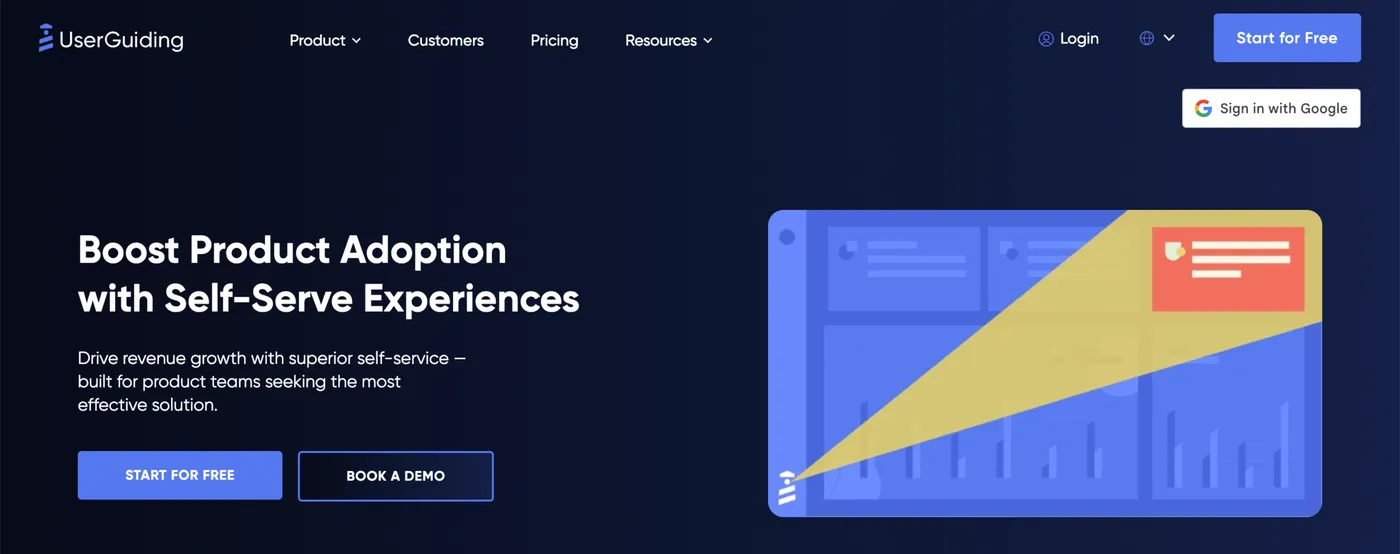
UserGuiding is a no-code onboarding and self-serve support platform that competes with Userpilot mainly on price. It covers a similar spread of in-app guidance features, but positions itself as the lower-cost, better-value option.
Pricing. From $174/month. Free trial available.
What it does well. UserGuiding bundles a broad onboarding and support toolkit: product tours, hotspots, tooltips, onboarding checklists, in-app surveys, NPS, resource centers, a knowledge base, an AI assistant, product updates pages, and banners. Its entry pricing undercuts Userpilot: the Starter plan is $174/month billed yearly, against Userpilot’s $299/month Starter, and UserGuiding publishes its Growth price ($349/month) too, where Userpilot quotes everything above Starter. It also has a free-forever plan, that covers a knowledge base, product updates, AI assistant, and resource center, and it backs paid plans with a 30-day money-back guarantee. Like Userpilot, it’s fully no-code.
Where it falls short. UserGuiding is lighter than Userpilot on product analytics. Its reporting centers on material engagement analytics and performance reports, while Userpilot offers funnels, retention, and paths. It’s also web only: UserGuiding’s own FAQ states it “doesn’t support native mobile apps at the moment,” whereas Userpilot offers native iOS and Android. And it has no email engagement feature, which Userpilot includes on its Growth plan.
Best for. Teams that want a broad, no-code onboarding and support toolkit at a lower price than Userpilot, are happy on web only, and don’t need deep product analytics.
Going deeper into UserGuiding? See our UserGuiding alternatives & competitors post.
4. Appcues
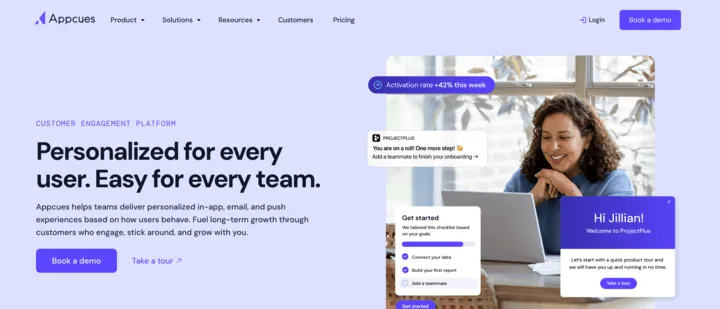
Appcues has been building product adoption tools for over a decade and is a direct Userpilot competitor. Its core pitch is that every plan includes the full platform, with no features gated behind higher tiers.
Pricing. Not published. All three Appcues plans (Start, Grow, Enterprise) are sales-led, with no public dollar amounts. Vendr, which tracks real contract data, puts the median Appcues deal at $15,000 per year.
What it does well. Appcues doesn’t gate features by tier. Every plan includes every experience type, integration, and feature from day one, where Userpilot reserves funnels, retention, paths, surveys, and A/B testing for higher tiers and sells session replay and mobile as add-ons. It’s also multi-channel: in-app messaging, behavioral email, and push notifications are all built in, alongside native mobile experiences. And every Appcues plan, including the entry Start plan, comes with onboarding and a dedicated customer success manager, where Userpilot reserves a dedicated CSM for its Enterprise plan.
Where it falls short. Appcues makes you talk to sales. None of its three plans show a price, and even the free trial is sales-gated, where Userpilot publishes its Starter price ($299/month) and lets you start a 14-day trial with no credit card. The entry Start plan also caps you at 10 published experiences and 3,000 monthly active users.
Best for. Teams that want the entire platform without feature gating, value multi-channel messaging and hands-on onboarding support, and don’t mind a sales-led buying process.
Going deeper into Appcues? See our Appcues alternatives & competitors post.
5. Chameleon
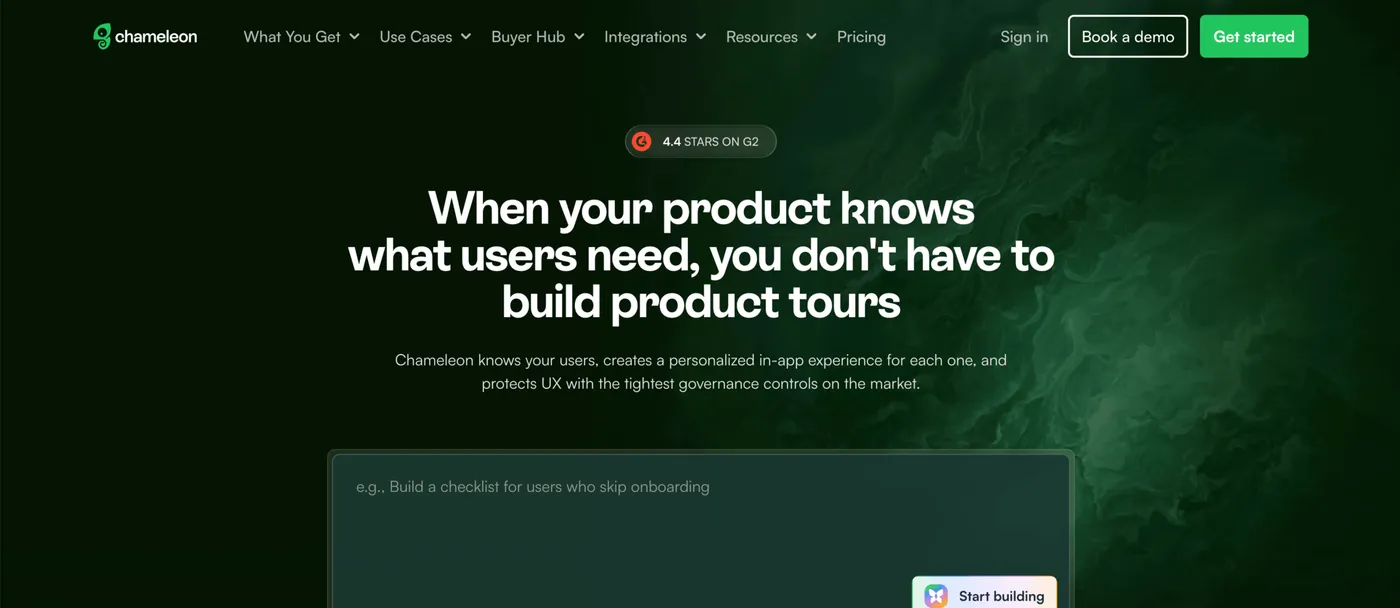
Chameleon is a direct Userpilot competitor that leans on deep customization and native-feeling in-app experiences. It’s a mid-market product adoption platform built around tours, tooltips, surveys, launchers, and banners.
Pricing. From $279/month. Free trial available.
What it does well. Chameleon includes its core in-app UX patterns, product tours, banners, checklists and resource centers, NPS and microsurveys, and tooltips, on every plan, rather than gating them by tier the way Userpilot does. Custom CSS is available from the entry Startup plan, where Userpilot reserves it for higher tiers. Chameleon also comes with an AI agent that plans and builds in-app campaigns, and another one that scans your account and suggests weekly fixes.
Where it falls short. Userpilot includes full product analytics with funnels, retention, and paths. Chameleon’s analytics are oriented around how your in-app experiences perform, like its Engagement Index. Userpilot also offers session replay and email engagement, neither of which Chameleon lists.
Best for. Teams that want deep customization and control over their in-app experiences, without features gated behind higher tiers, and that don’t need product analytics or session replay.
6. Userflow
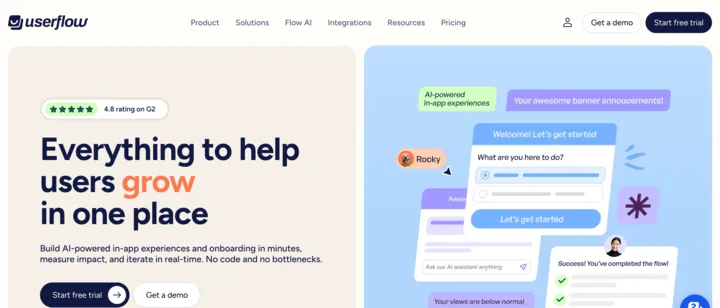
Userflow is a direct mid-market Userpilot competitor that positions itself as an AI-powered product adoption and onboarding platform.
Pricing. From $240/month. Free trial available.
What it does well. Userflow covers a focused onboarding toolkit: tours and guides, checklists, a resource center, tooltips, banners and announcements, and NPS and surveys. AI runs through the product, including an Adoption Agent, a flow builder, and translation, with AI credits included on every plan. It connects to a broad set of tools, including Segment, Amplitude, Mixpanel, HubSpot, and Salesforce.
Where it falls short. Userpilot offers session replay, native mobile, email engagement, and A/B testing. None of these appear in Userflow’s feature comparison.
Best for. Teams that want an AI-forward onboarding and product adoption platform with a focused feature set, and that don’t need session replay, native mobile, or email.
7. Jimo
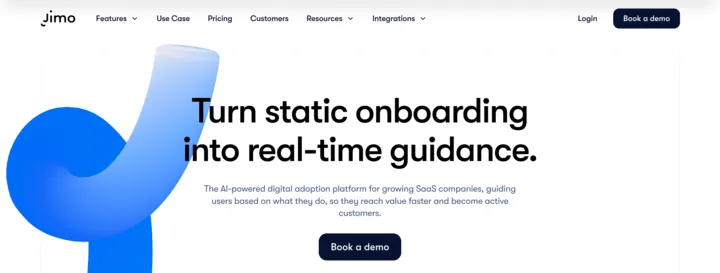
Jimo is an AI-forward product adoption platform and a direct mid-market Userpilot competitor. AI runs through most of its experience types, from product tours to its resource center and hints.
Pricing. From $249/month. Free trial available.
What it does well. Jimo covers a broad set of in-app experiences: AI product tours, an AI resource center, checklists, surveys and NPS, AI hints and hotspots, banners and announcements, an in-app changelog, and a feedback widget. It publishes more pricing than Userpilot: the Starter plan is $249/month billed yearly for 2,500 monthly active users, and the Growth plan is a public $499/month, where Userpilot publishes only its $299 Starter price and quotes the rest. The free trial runs 21 days with full functionality and no credit card.
Where it falls short. Jimo doesn’t support native mobile. Its own FAQ says native iOS and Android apps are “coming soon” but not available yet, where Userpilot offers both. Userpilot also offers session replay and email engagement, neither of which appears in Jimo’s feature comparison.
Best for. Teams that want a broad in-app experience toolkit with AI woven through it, at a lower and more transparent entry price than Userpilot, and that don’t need native mobile, session replay, or email.
8. Intercom Product Tours
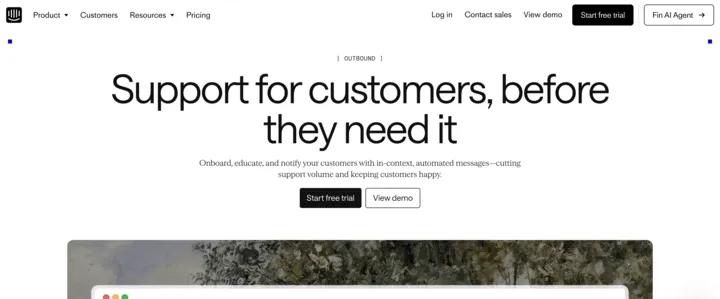
Intercom Product Tours is an onboarding feature inside Intercom, the customer service platform, rather than a standalone product. That makes it a real Userpilot alternative for one specific group: teams already running support on Intercom.
Pricing. Product Tours isn’t sold on its own. It comes through Intercom’s Proactive Support Plus add-on at $99/month, which also includes Posts, Checklists, Surveys, and the Series campaign builder, on top of an Intercom plan that starts at $29 per seat per month. Free trial available.
What it does well. If you already use Intercom for support, Product Tours runs on the same platform as the rest of your customer communication: the same Messenger, the same customer data, the same targeting, and the Series builder that sequences tours together with its other channels like email, chat, and push. It’s code-free, and you avoid standing up and maintaining a separate tool.
Where it falls short. Product Tours is one feature inside a customer service suite, not a dedicated product adoption platform, and it’s priced like one: you pay per support seat plus a $99/month add-on, where Userpilot prices on monthly active users. If you aren’t already an Intercom customer, adopting it just for product tours means paying for a whole support platform you don’t need. Userpilot, by contrast, is purpose-built for product adoption, with product analytics like funnels, retention, and paths.
Best for. Teams already using Intercom for customer support who want basic onboarding tours inside the tool they already run, and don’t need a dedicated product adoption platform.
Analytics-heavy and enterprise platforms
9. Pendo
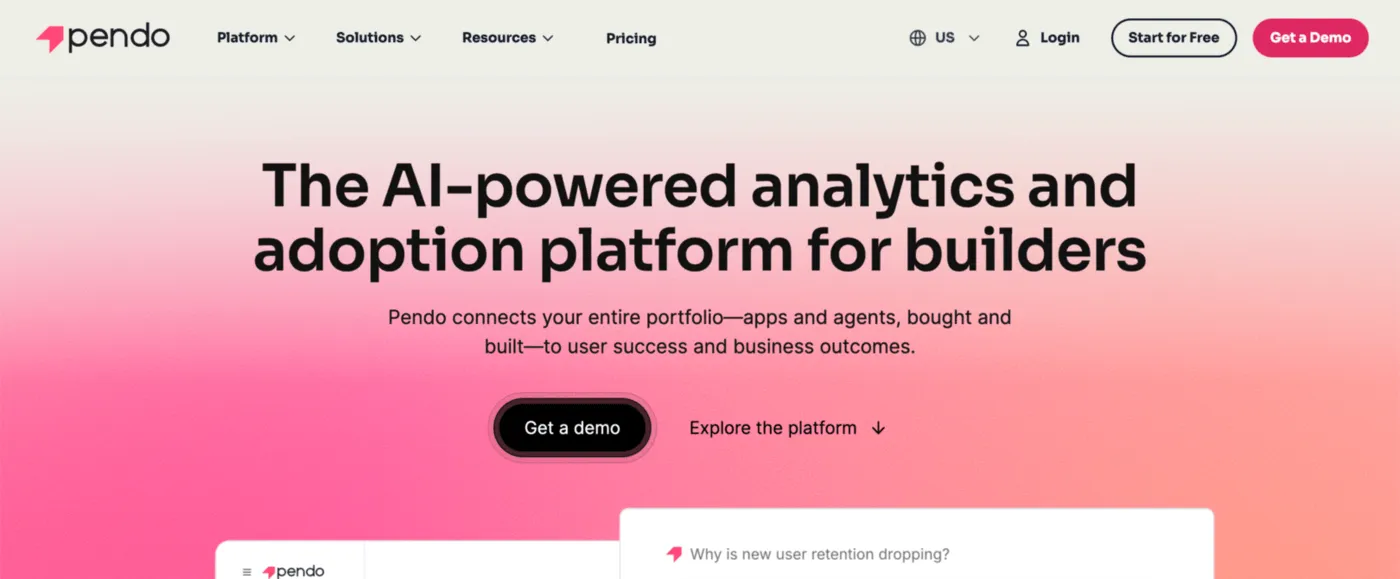
Pendo is a much larger platform than Userpilot. It’s a full product analytics and digital adoption suite, and it sits at the heavyweight end of this list: the option for teams that have outgrown a focused onboarding tool.
Pricing. Not published. Pendo’s paid tiers (Base, Core, Ultimate) are all custom-quoted. Vendr puts the median Pendo contract at $49,000 per year. There is also a free tier for up to 500 monthly active users.
What it does well. Pendo is broader and deeper than Userpilot on almost every axis. Product analytics is its core, and the platform also includes session replay, NPS and sentiment surveys, user feedback collection, product roadmaps, and churn prediction. It offers something Userpilot doesn’t: a free-forever plan for up to 500 monthly active users, alongside a 30-day trial of the full platform.
Where it falls short. Pendo is expensive and entirely sales-led. Every paid tier is a custom quote with no public price, and Vendr’s median contract sits around $49,000 per year, against roughly $11,000 for Userpilot. It’s also more platform than many teams need. If you mainly want onboarding flows and in-app guidance, Pendo is a large, costly system to take on for that slice of the job.
Best for. Teams that want a full product analytics and adoption platform in one place, have the budget for an enterprise-scale contract, and would otherwise be buying analytics and onboarding as separate tools.
Going deeper into Pendo? See our Pendo alternatives & competitors post.
10. WalkMe
WalkMe is an enterprise digital adoption platform, and it solves a slightly different problem than Userpilot. Where Userpilot helps a SaaS company onboard its own customers, WalkMe helps a large organization drive adoption of the internal software its employees use, overlaying guidance across Salesforce, Workday, ServiceNow, and the rest of an enterprise app portfolio.
Pricing. Not published. WalkMe is sales-led and priced per user across desktop, mobile, and web. Vendr puts the median WalkMe contract at $39,000 per year, with implementation quoted separately and commonly running $15,000 to $150,000 or more.
What it does well. If cross-application, enterprise-wide digital adoption is actually your problem, WalkMe is purpose-built for it in a way Userpilot is not. It overlays every application across desktop, mobile, and web, automates multi-step workflows, and includes its own analytics layer. It’s no-code, and it’s backed by a large enterprise partner and certification ecosystem.
Where it falls short. For most teams shopping Userpilot, WalkMe is the wrong category. It’s built for internal employee adoption across an enterprise’s app portfolio, not for onboarding your customers onto your own product. It’s also heavier on every front: no public pricing, no free trial, a sales-led process, per-user enterprise pricing instead of Userpilot’s monthly-active-user model, and implementation costs that can rival the software itself.
Best for. Large organizations that need to drive adoption of internal software across many applications and teams, with the budget and implementation capacity for an enterprise rollout. It’s not the tool for a SaaS team that just wants to onboard its own users.
11. Whatfix
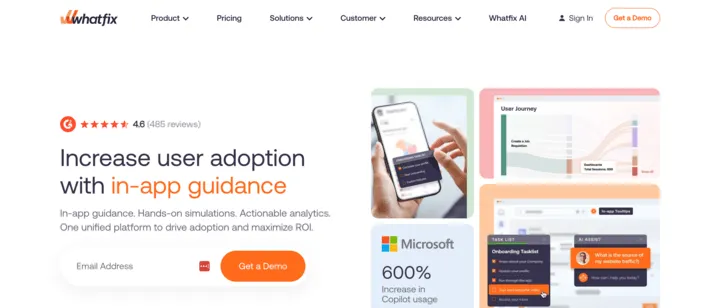
Whatfix is an enterprise digital adoption platform, and like WalkMe above, it’s aimed at a slightly different problem than Userpilot. Whatfix is built to help large organizations get their employees productive on complex internal software, with a strong emphasis on training: alongside in-app guidance, it offers hands-on simulations and AI roleplay for skill-building. Its customers skew to regulated enterprise verticals like banking, healthcare, insurance, and government.
Pricing. Not published. Whatfix is sales-led, with Standard, Premium, and Enterprise tiers all quoted on request. Vendr, which tracks real contract data, puts the median Whatfix contract at $31,950 per year, before add-ons like professional services.
What it does well. For enterprise digital adoption, Whatfix is a serious platform. It pairs in-app guidance with something most onboarding tools don’t have: hands-on simulations and AI-powered roleplay for building skills and practicing workflows. It also includes its own product analytics, AI content authoring from plain-text prompts, and embedded user support.
Where it falls short. Like WalkMe, Whatfix is solving for internal employee adoption across an enterprise’s software, not for onboarding customers onto a SaaS product. If you’re a product team evaluating Userpilot, you’d be buying an enterprise training and adoption platform for a job it isn’t shaped around. It’s also sales-led with no public pricing and no free trial, where Userpilot publishes a $299/month Starter plan and a self-serve trial.
Best for. Large enterprises, especially in regulated industries, that need to onboard employees onto complex internal systems and want simulation-based training alongside in-app guidance. Like WalkMe, it’s not built for a SaaS team onboarding its own users.
How to choose between them
A quick way to narrow down based on what’s pushing you away from Userpilot.
By priority:
- Cheaper in-app guidance, no analytics bundle: FlowNavi or Product Fruits
- A broad onboarding toolkit at a lower price: UserGuiding
- The whole platform with nothing gated, plus email and push: Appcues
- Deep customization and native-feeling design: Chameleon
- AI-forward onboarding at the mid-market level: Userflow or Jimo
- Onboarding inside a tool you already run for support: Intercom Product Tours
- Deeper product analytics and a wider platform: Pendo
- Enterprise employee adoption across internal apps: WalkMe or Whatfix
Two things worth watching for:
Half this list won’t show you a price. Appcues, Pendo, WalkMe, and Whatfix are all sales-led, and Intercom’s tours sit behind an add-on on a multi-tier platform. Userpilot itself only publishes its Starter price. If you want to evaluate, trial, and buy without a sales cycle, the realistic shortlist is the tools with public pricing: FlowNavi, Product Fruits, UserGuiding, Chameleon, Userflow, and Jimo.
Enterprise Digital Adoption Platforms solve a different problem. WalkMe and Whatfix are built to help employees use internal business software, not to onboard customers onto your SaaS product. They show up in searches like this one, but if your use case is customer-facing onboarding, they’re the wrong category. Pendo straddles the line: it does customer-facing product adoption, but it’s a much heavier and more expensive platform than the rest of this list.
Summary
| Tool | Target | Starting price | Key strength |
|---|---|---|---|
| Userpilot | Mid-market SaaS | $299/mo | Onboarding plus built-in product analytics |
| FlowNavi | SMB and mid-market SaaS | $79/mo | Full guide set on the cheapest plan |
| Product Fruits | SMB SaaS | $111/mo | Broad onboarding and support bundle with AI |
| UserGuiding | SMB SaaS | $174/mo | Broad bundle (tours, KB, AI) with a free tier |
| Appcues | Mid-market SaaS | Custom | Full platform on every plan, multi-channel |
| Chameleon | Mid-market SaaS | $279/mo | Deep customization, native-feeling design |
| Userflow | Mid-market SaaS | $240/mo | AI-forward onboarding toolkit (FlowAI) |
| Jimo | Mid-market SaaS | $249/mo | AI woven through a broad experience set |
| Intercom Product Tours | Teams already on Intercom | $99/mo add-on | Onboarding inside the Intercom platform |
| Pendo | Mid-market to Enterprise | Free + Custom | Deep product analytics and adoption suite |
| WalkMe | Enterprise | Custom | Enterprise DAP for internal software adoption |
| Whatfix | Enterprise | Custom | Enterprise DAP with training simulations |
FAQ
What’s the cheapest Userpilot alternative?
Among dedicated onboarding tools with public pricing, FlowNavi is the cheapest starting at $79/month, covering product tours, tooltips, checklists, and hotspots. Product Fruits starts at $111/month and UserGuiding’s Starter plan at $174/month. UserGuiding also has a free-forever plan, but it’s limited to help-center features like a knowledge base and AI assistant, with no product tours. For comparison, Userpilot’s own entry plan is $299/month.
Are there free or open-source Userpilot alternatives?
For free plans, UserGuiding offers a free-forever tier, though it covers help-center features (knowledge base, AI assistant, resource center) rather than product tours. Pendo has a free tier for up to 500 monthly active users that includes product analytics, in-app guides, and NPS. Most other tools offer free trials of 14 to 30 days but not free plans. On the open-source side, there are free JavaScript tour libraries, the most established being Intro.js, Shepherd.js, and Driver.js, but they only handle the tour itself: your team builds and maintains the logic, analytics, and targeting.
Userpilot vs Pendo: which one wins?
It depends on scope and budget. Userpilot is a mid-market product adoption platform focused on onboarding flows plus product analytics; its entry plan is $299/month and the median contract runs around $11,300/year (Vendr). Pendo is a much broader and deeper platform, with product analytics at its core plus session replay, user feedback, roadmaps, and churn prediction; its paid tiers are all custom-quoted and the median contract is around $49,000/year (Vendr). Pendo is the stronger fit if you want a full analytics-and-adoption suite and have the budget for it. Userpilot is the better fit if you want focused onboarding and analytics without an enterprise-scale contract.
What’s the difference between Userpilot and Appcues?
Userpilot and Appcues are direct competitors, both product adoption platforms priced on monthly active users. The main differences come down to pricing transparency and feature gating. Userpilot publishes its entry price ($299/month) but gates features by tier, reserving funnels, retention, paths, surveys, and A/B testing for higher plans and selling session replay and mobile as add-ons. Appcues publishes no pricing at all (every plan is sales-led) but includes the entire platform on every plan with no feature gating, plus behavioral email and push notifications alongside in-app messaging, and a dedicated customer success manager even on its entry plan.
How much does Userpilot actually cost?
Userpilot’s Starter plan is $299/month billed annually, covering up to 2,000 monthly active users. The Growth and Enterprise plans don’t have public prices; both are custom-quoted. Looking at real contracts, Vendr puts the median Userpilot deal at around $11,300/year, with most buyers paying between $3,000 and $36,000/year depending on user volume and plan. Note that session replay and mobile engagement are paid add-ons even on the Growth and Enterprise plans, and contracts often carry annual price increases of 5 to 10 percent.
Which Userpilot alternative is best for small teams?
For small SaaS teams, the best fits are the lower-cost tools with public pricing and self-serve signup. FlowNavi ($79/month) is built specifically for small teams and solo founders and covers the core onboarding patterns. Product Fruits ($111/month) adds a knowledge base and an AI support agent. UserGuiding has a free-forever tier plus a $174/month Starter plan. All three let you trial and buy without a sales call. The enterprise platforms in this space, Pendo, WalkMe, and Whatfix, are built for large organizations and priced accordingly, so they’re rarely the right fit for a small team.