
10 Best Inline Manual Alternatives & Competitors in 2026 (for user onboarding)
The ten tools below are alternatives to Inline Manual, ranging from user onboarding and feature adoption tools, to enterprise digital adoption platforms. For each, we’ll list the price, what it does better than Inline Manual, where it falls short, and who it fits.
FlowNavi: the same onboarding, cheaper and without the content controls
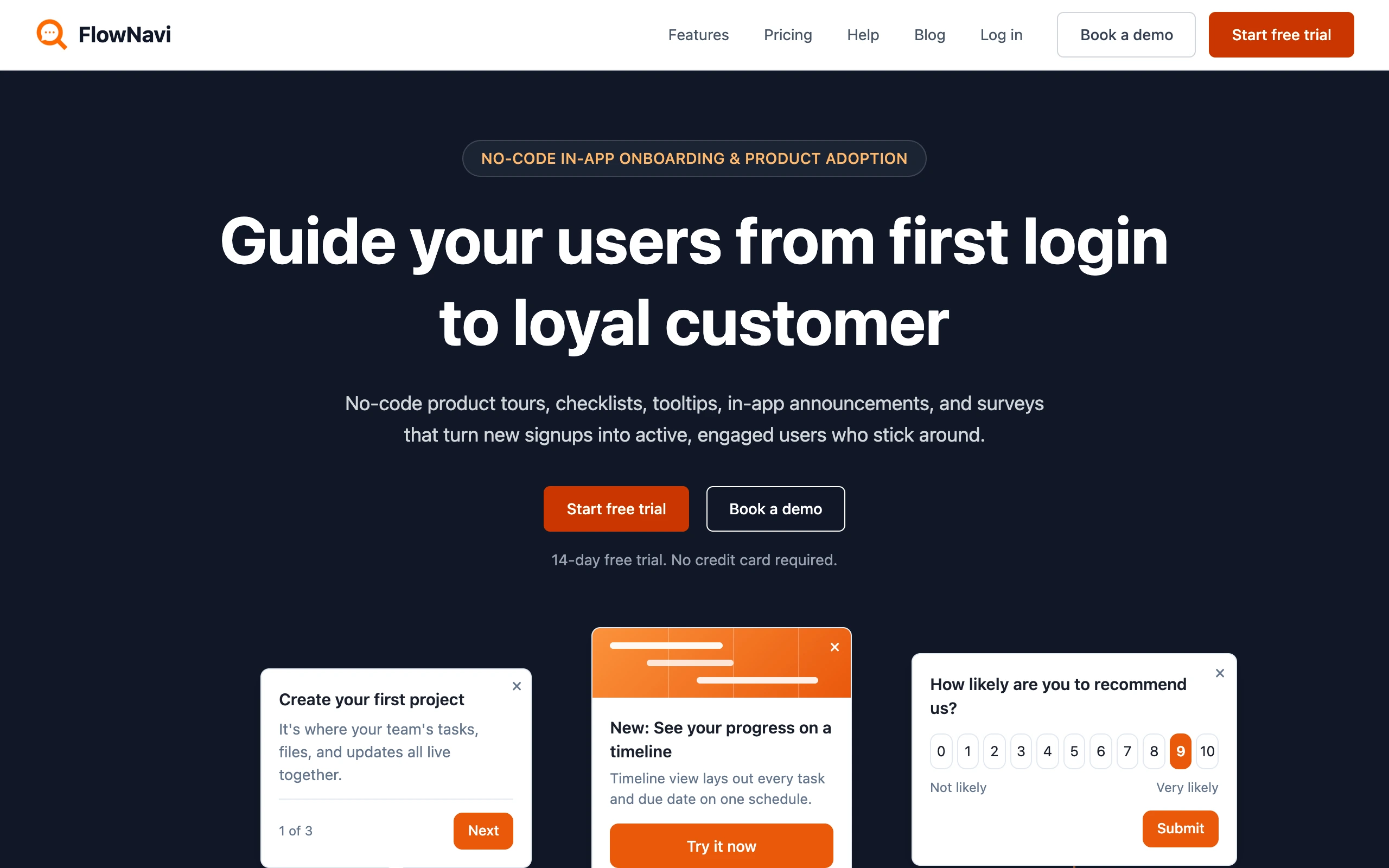
FlowNavi covers the same in-app onboarding as Inline Manual: product tours, checklists, tooltips, announcements, and surveys, but strips out the content-management layer of Inline Manual.
Pricing. $79/month for up to 1,000 monthly active users, with a free trial. Every plan includes every feature.
What it does well. Simplicity of pricing: For $79/month, you get the whole platform. Higher tiers only buys more monthly active users. Setup is a single JavaScript snippet, and after that non-engineers can build and publish guides.
Where it falls short. No version control or branches, as well as no localization. Further, FlowNavi’s main use case is user onboarding, while Inline Manual supports employee onboarding/training in addition to user onboarding.
Best for. Teams onboarding their users that want user onboarding and feature adoption software at a predictable price.
Disclosure: FlowNavi is our own product.
UserGuiding: no-code onboarding with a knowledge base and AI assistant
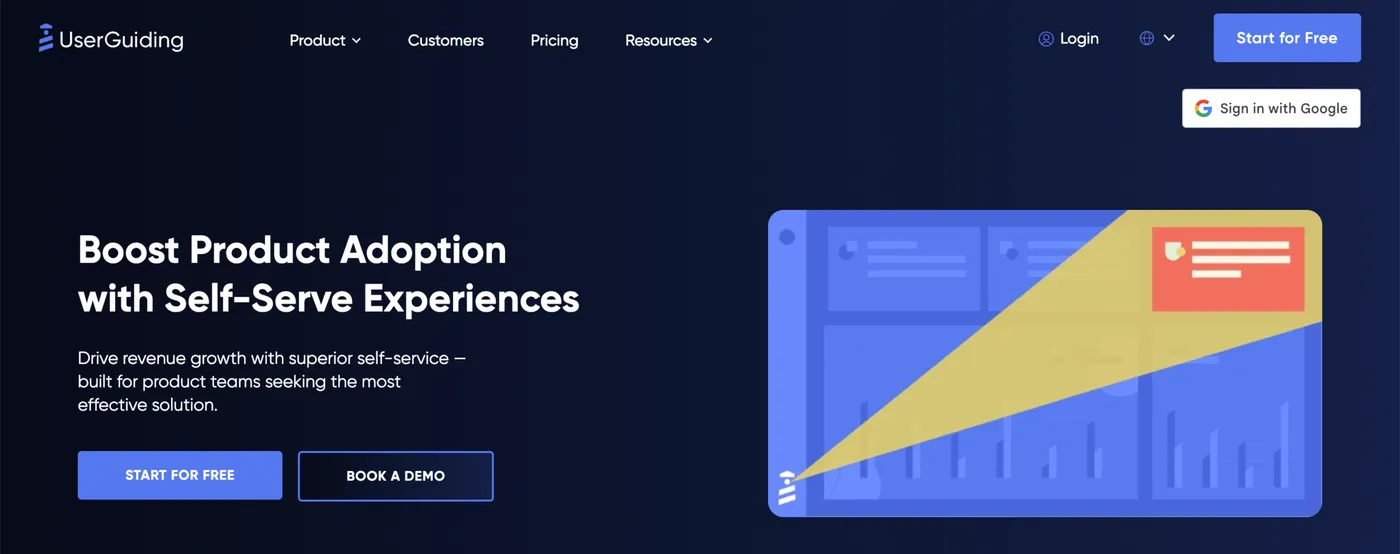
UserGuiding is a no-code user onboarding tool priced close to Inline Manual. It bundles onboarding, a knowledge base, and an AI support chatbot into one plan.
Pricing. From $174/month for 2,000 monthly active users, with a limited free plan and a free trial.
What it does well. AI support chatbot: it answers your users’ questions from your help docs, which Inline Manual doesn’t have. A/B testing and session replay are included in the same plan. Localization is supported: your language plus three more on Growth, and unlimited on Enterprise.
Where it falls short. No version control, branches, or staged release, and no offline mode. Reviewers also note a dense dashboard that takes time to learn.
Best for. Teams that want a knowledge base and an AI support chatbot alongside their user onboarding, in one no-code tool.
Userpilot: product adoption plus product analytics in one tool
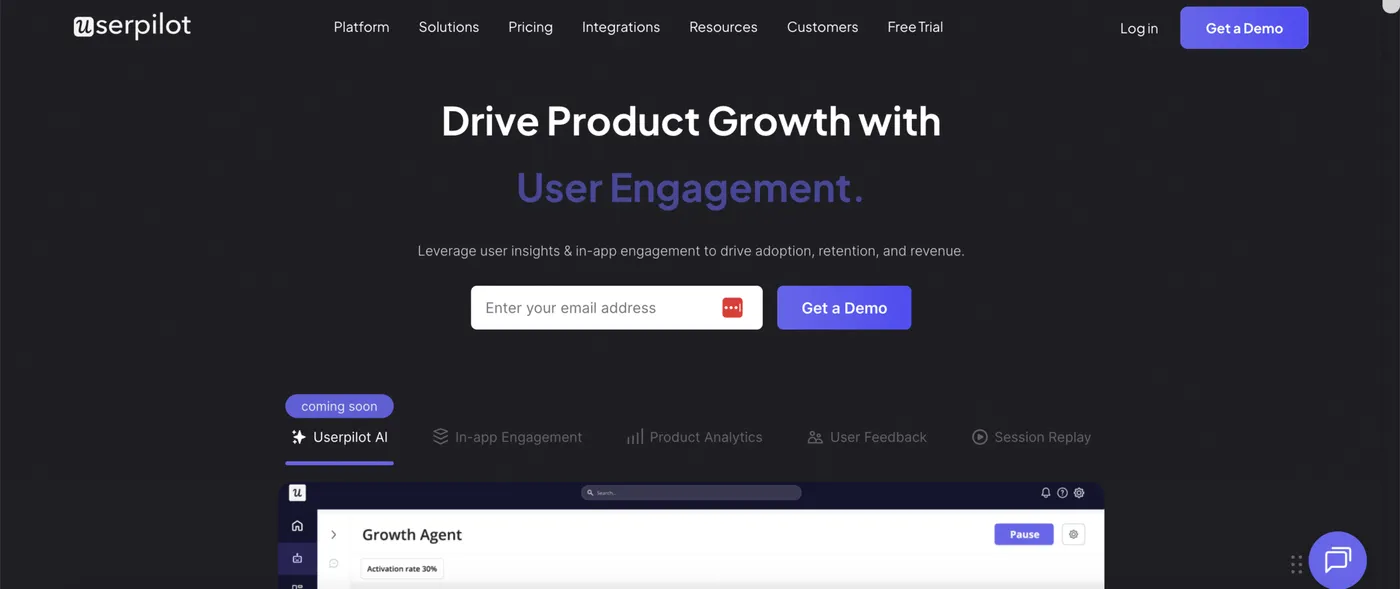
Userpilot is a product adoption tool that pairs onboarding with product analytics in one subscription.
Pricing. From $299/month for 2,000 monthly active users, billed annually. Vendr puts the median deal near $11,000/year.
What it does well. Product analytics: Inline Manual’s reporting shows whether a guide was seen. Userpilot adds funnels, retention, and paths, so you can see whether onboarding led to activation. Localization is supported.
Where it falls short. The analytics are on the quote-based Growth tier, above the $299 entry, and session replay and mobile are paid add-ons. No version control or branches.
Best for. Teams that want user onboarding and product analytics in one mid-market tool.
Appcues: multi-channel product adoption
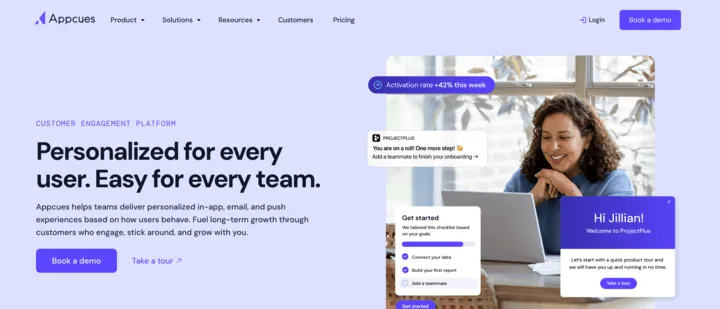
Appcues is a product adoption tool for web and mobile apps that can also reach users by email and push notifications.
Pricing. Not public. Vendr puts the median contract near $15,000/year, with entry deals around $249/month for 2,500 users.
What it does well. Multiple channels: alongside in-app guides, it sends behavioral email and push, and its mobile SDK runs guides inside iOS and Android apps. Inline Manual is web only. Localization is supported.
Where it falls short. It costs more than Inline Manual and doesn’t publish pricing. No version control or branches, and no employee onboarding.
Best for. Teams onboarding users across web, email, push, and native mobile from one tool.
Chameleon: highly customizable in-app experiences
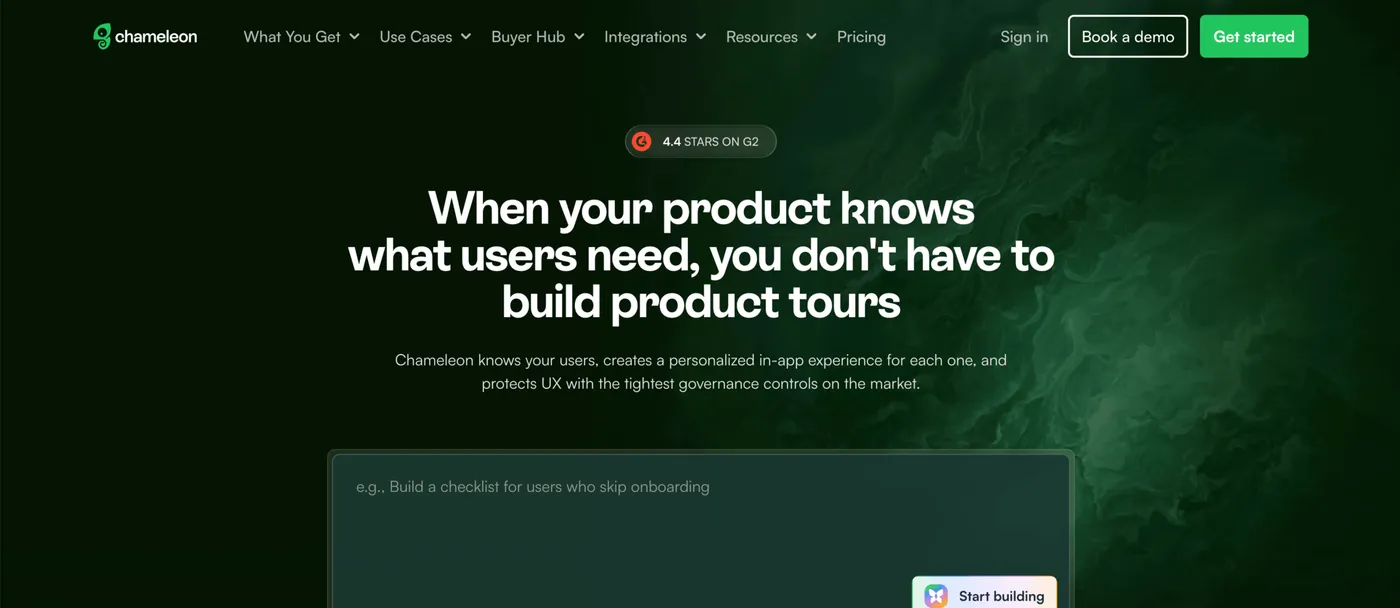
Chameleon is a product adoption tool focused on customizing how in-app content looks, with A/B testing built in.
Pricing. From $279/month for 1,000 monthly tracked users. The next tier, Growth, starts at $15,000/year.
What it does well. Customization and testing: custom CSS makes a tooltip or modal match your product’s design, A/B testing compares versions, and frequency controls limit how often a user is interrupted. Inline Manual has none of these.
Where it falls short. Localization is on the Enterprise plan only. The step from $279/month to Growth’s $15,000/year is large, it’s web only, and there’s no version control or offline mode.
Best for. Teams that want customizable in-app content and A/B testing.
Userflow: no-code onboarding with a built-in AI assistant
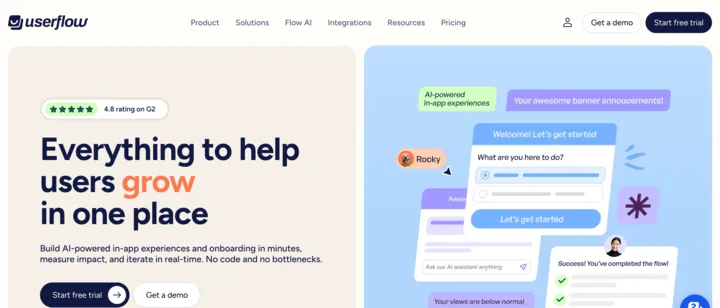
Userflow is a no-code user onboarding tool known for fast building, with a built-in AI assistant.
Pricing. From $240/month for 3,000 monthly active users, billed annually. Pro is $680/month.
What it does well. Speed and AI: an in-app AI assistant answers users’ questions from your help content, and AI drafts and localizes guide copy. Building is faster than Inline Manual’s versioned workflow.
Where it falls short. The step from $240 to Pro’s $680 is steep, and it’s web only. No version control, offline mode, or employee onboarding.
Best for. Teams that want fast, no-code onboarding with an AI assistant.
Jimo: AI-generated product tours from a recording
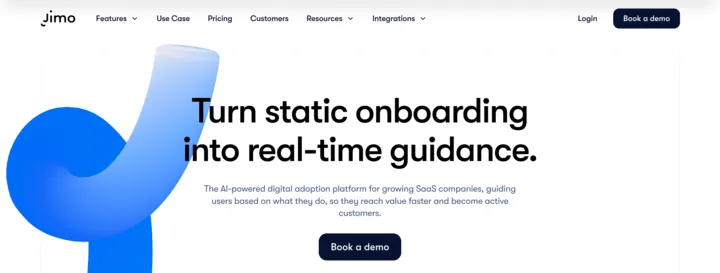
Jimo is a product adoption tool whose main feature is AI tour creation: record a flow in your product, and its AI drafts the tour.
Pricing. From $249/month.
What it does well. AI tour creation: you demonstrate a flow once and edit what the AI produces, instead of building each step by hand. A built-in analytics layer tracks how the tours perform.
Where it falls short. It’s newer and smaller than Inline Manual. No version control or branches, no localization near 70 languages, and no offline deployment.
Best for. Teams that want AI to build their tours instead of building each step by hand.
Pendo: product analytics and adoption, for users and employees
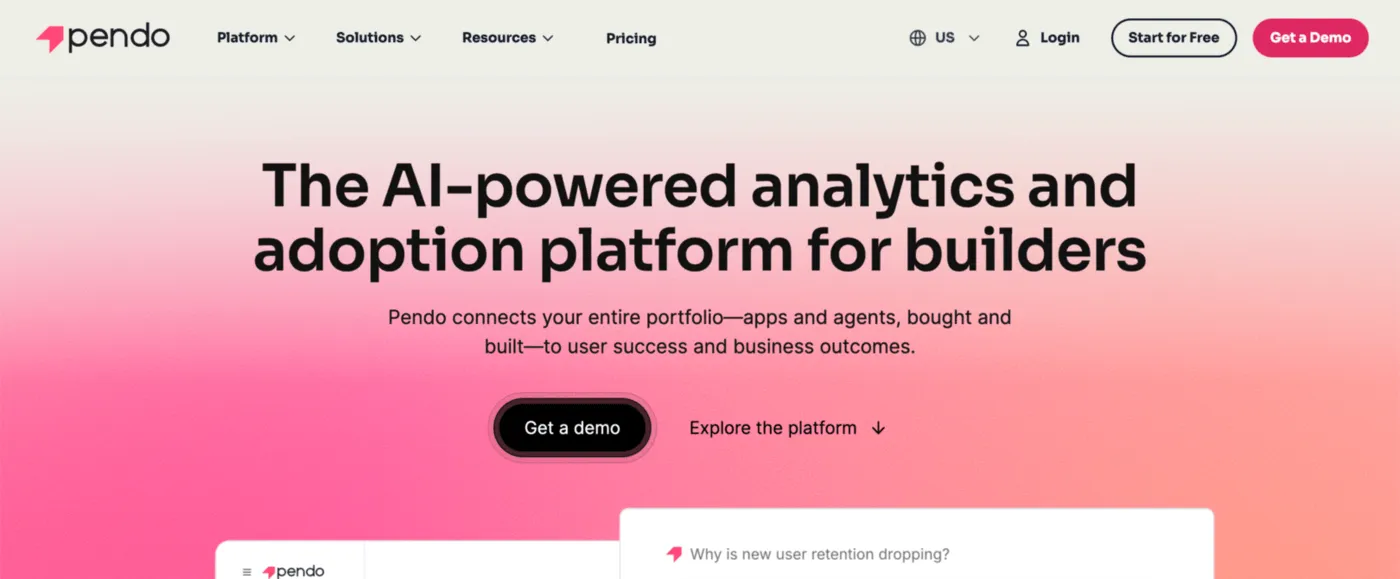
Pendo is a product analytics and adoption platform that, like Inline Manual, covers both user onboarding and employee training.
Pricing. Free up to 500 monthly active users, then quote-based. Vendr puts the median near $49,000/year.
What it does well. Analytics and reach: it adds funnels, retention, paths, and session replay, plus native mobile and a free tier. Like Inline Manual, it works for both users and employees.
Where it falls short. Paid plans are quote-based and get expensive at scale, and reviewers note a steep learning curve. No version control or offline mode.
Best for. Teams that want deep product analytics and mobile while covering both users and employees, and can absorb the cost.
Whatfix: enterprise employee onboarding with practice simulations
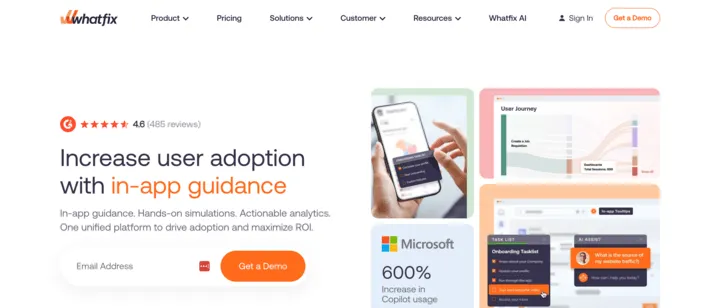
Whatfix is an enterprise digital adoption platform for training employees on internal software.
Pricing. Not public. Vendr puts the median contract near $32,000/year.
What it does well. Practice simulations: a working copy of an app where staff rehearse a task before doing it live, with readiness tests. Inline Manual’s employee mode doesn’t do this. It covers desktop and mobile, not just the web.
Where it falls short. It’s built for employees, not user onboarding. Enterprise pricing and a multi-week rollout, against Inline Manual’s $158/month.
Best for. Companies whose internal training has outgrown Inline Manual, especially where staff must rehearse before the live system.
WalkMe: enterprise digital adoption across many internal apps
WalkMe is an enterprise digital adoption platform that guides employees across many internal systems from one layer on top of the software.
Pricing. No public price. Vendr puts the median near $39,000/year, with implementation billed separately.
What it does well. Cross-app guidance: one deployment can guide staff through SAP, Salesforce, and Workday in a single flow, on desktop and mobile, without changing the underlying code.
Where it falls short. It’s for employees, not user onboarding, and it’s the most expensive and slowest to set up here, with implementation that can cost as much as the license. Inline Manual is far cheaper and faster to launch.
Best for. Large organizations driving adoption of internal software across many apps and thousands of staff.
When Inline Manual is the right pick
Comparing alternatives doesn’t rule Inline Manual out. It’s the right pick when the content itself is the hard part.
For a large library of guides that changes often, version control matters: you can save versions, branch a change to test it, and roll back a release that breaks something. Most tools here can’t.
For onboarding in many languages, Inline Manual localizes into up to 70. Some alternatives localize too, but not that far.
For teams that need user onboarding and employee training in one tool, Inline Manual does both, at a price small teams can afford. Only Pendo does the same, at a far higher cost.
For security-sensitive setups, it can run offline, which the cloud-only tools here can’t.
If you want a lower price, product analytics, AI authoring, or mobile reach instead, the tools above go further.
How to choose between them
Start with what pushed you off Inline Manual:
- A lower price for the same onboarding: FlowNavi
- A knowledge base and AI support chatbot: UserGuiding
- Product analytics on top of onboarding: Userpilot or Pendo
- Reaching users on mobile, email, and push: Appcues
- Customization and A/B testing: Chameleon
- Fast building with an AI assistant: Userflow
- AI that builds tours from a recording: Jimo
- Training employees on internal software at scale: Whatfix or WalkMe
If instead you value versioned content, localization into many languages, offline running, or one tool for both users and employees, most of these give up at least one. Pendo comes closest on covering both, and Whatfix and WalkMe go deeper on the employee side, but none match Inline Manual’s mix at its price.
Summary
| Tool | Onboards | Price | Stands out for |
|---|---|---|---|
| Inline Manual | Users + employees | From $158/mo | Versioning, 70-language localization, offline |
| FlowNavi | Users | $79/mo | Low price, every feature included |
| UserGuiding | Users | $174/mo | Knowledge base and AI support chatbot |
| Userpilot | Users | $299/mo | Funnels, retention, paths |
| Appcues | Users | ~$15k/yr | Email, push, and guides in mobile apps |
| Chameleon | Users | $279/mo | Custom CSS, A/B testing |
| Userflow | Users | $240/mo | Fast building, AI assistant |
| Jimo | Users | $249/mo | AI builds tours from a recording |
| Pendo | Users + employees | Free + ~$49k/yr | Deep analytics, mobile, free tier |
| Whatfix | Employees | ~$32k/yr | Practice simulations, assessments |
| WalkMe | Employees | ~$39k/yr | Guidance across many internal apps |
FAQ
How much does Inline Manual cost?
Inline Manual costs $158/month for 250 monthly active users to onboard customers, or $3 per employee per month to train staff on internal software. It runs a free trial, not a free tier. Localization reaches 3 languages on its mid plan and up to 70 on Enterprise.
Does Inline Manual do customer onboarding or employee onboarding?
Both. It onboards your customers and trains your employees on internal software from the same product, with a pricing page that switches between the two. Most alternatives pick a side: FlowNavi, UserGuiding, Userpilot, Appcues, Chameleon, Userflow, and Jimo focus on users, while Whatfix and WalkMe focus on employees. Pendo, like Inline Manual, does both.
What’s the best Inline Manual alternative?
It depends on why you’re switching. For a lower price on the same onboarding, FlowNavi. For a knowledge base and AI support chatbot, UserGuiding. For product analytics, Userpilot or Pendo. For mobile, email, and push, Appcues. For customization and A/B testing, Chameleon. For fast AI authoring, Userflow or Jimo. For enterprise employee training, Whatfix or WalkMe.
Which of these localize onboarding into other languages?
Inline Manual localizes guides into up to 70 languages. Among the alternatives, UserGuiding, Userpilot, Appcues, Userflow, Pendo, and WalkMe localize content too, though several cap the number of languages or gate it to higher tiers. FlowNavi and Chameleon are the exceptions: FlowNavi has no localization, and Chameleon only localizes on its Enterprise plan.
Is there a free Inline Manual alternative?
Inline Manual has a free trial, not a free tier. Pendo has a real free tier up to 500 monthly active users, and UserGuiding has a limited free plan covering its knowledge base and AI assistant, but not tours. FlowNavi and others run free trials. If you have engineering time, open-source libraries like Intro.js, Shepherd.js, and Driver.js are free to use, though your team builds and maintains everything.
What does Inline Manual do that these alternatives don’t?
Three things. It versions guide content, so you can branch a change to test it and roll it back. It localizes guides into up to 70 languages. And it onboards customers and trains employees from one product. It can also run offline. Where it trails: analytics, AI authoring, native mobile, and a more modern editor.