
9 Best Whatfix Alternatives & Competitors in 2026 (for user onboarding)
The nine tools below fall into two camps: product adoption tools that onboard the users of your own product, and enterprise digital adoption platforms built to get employees productive on internal software. For each one you’ll find current pricing, what it does and doesn’t do well, and who it fits, along with a note on the cases where Whatfix is still the better choice.
FlowNavi: Affordable product adoption software without feature gating
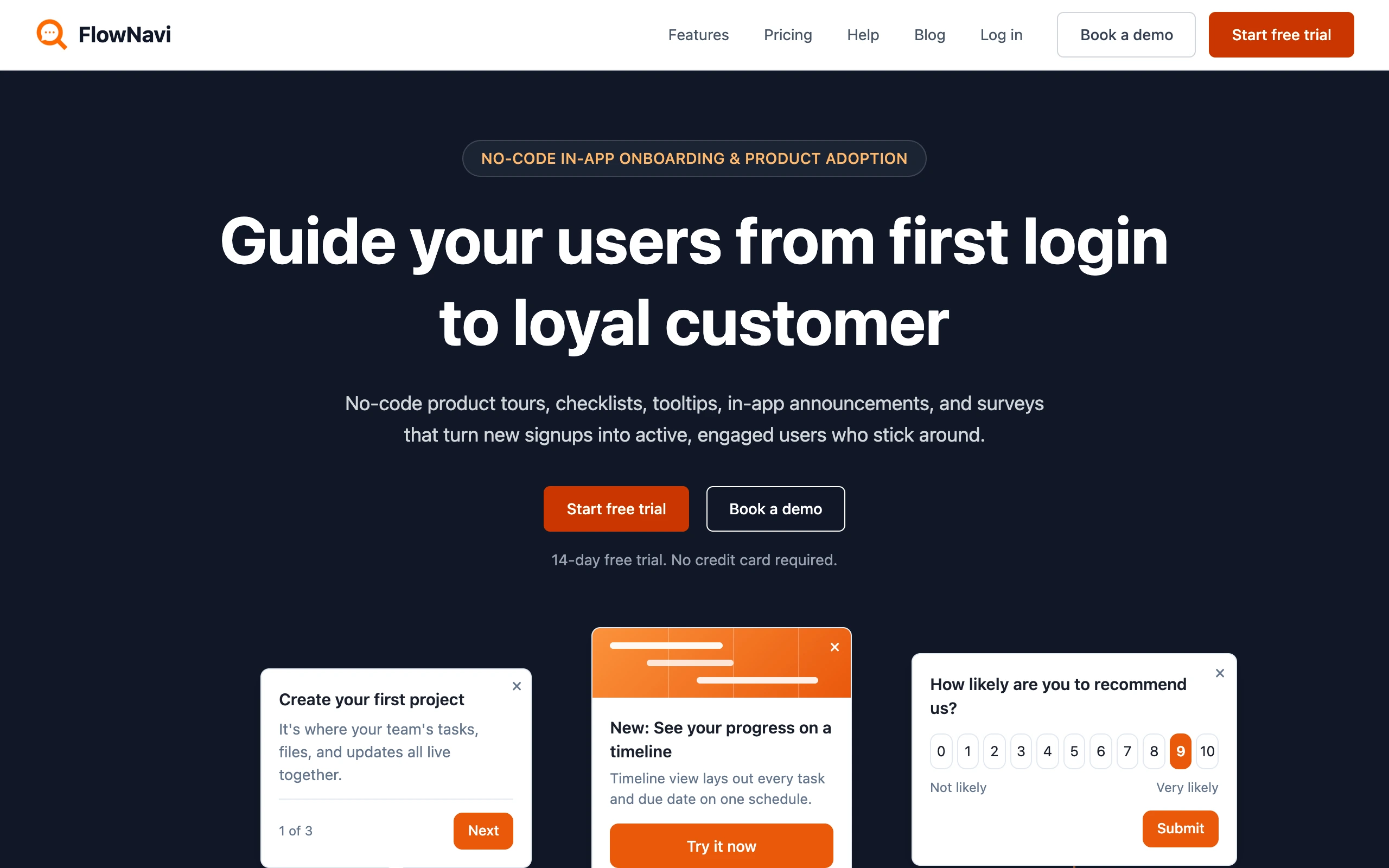
FlowNavi is a no-code product adoption platform covering product tours, checklists, tooltips, in-app announcements, and NPS and custom surveys, all aimed at your own customers inside the product you sell, rather than employees working in Salesforce or Workday.
Pricing. From $79/month with a free trial, and every plan includes every feature.
What it does well. There’s no starter-tier trap: the $79 plan already holds the whole toolkit, so higher tiers buy more usage rather than more features. After initial setup, it is genuinely no-code: non-engineers can build and publish guidance, and most teams are live within a day or two instead of the week to month long implementation an enterprise DAP like Whatfix often takes. Costs climb gradually with your active-user count rather than jumping between plans.
Where it falls short. Two capabilities are missing outright: an AI assistant and a resource center. More fundamentally, FlowNavi runs inside your own product, so the things Whatfix is designed for fall outside its scope, namely guiding staff across third-party software you don’t own, and standing up a Mirror-style sandbox where employees rehearse a process before doing it for real.
Best for. SMB and mid-market SaaS teams that want a complete product-adoption toolkit without per-feature paywalls or enterprise pricing.
Disclosure: FlowNavi is our own product.
Userpilot: product adoption plus product analytics in one tool
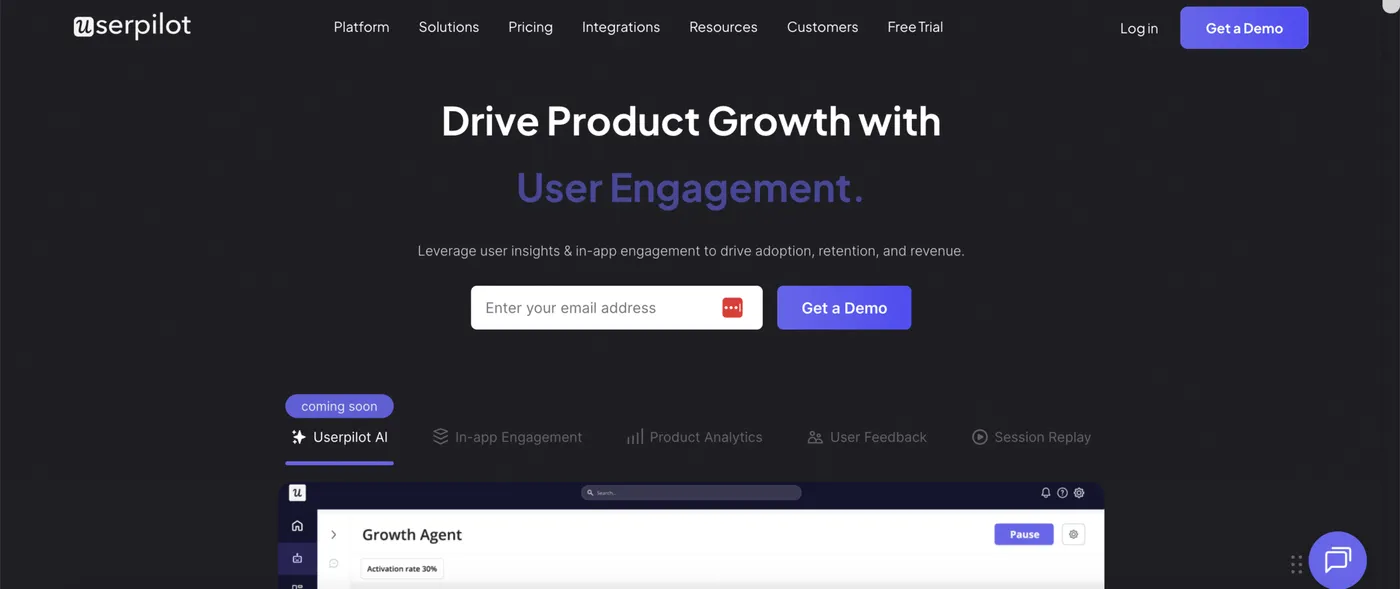
Userpilot folds together two jobs SaaS teams usually buy separately: product adoption (flows, checklists, tooltips, surveys) and product analytics (funnels, retention, paths). Everything lives inside your own product, so like FlowNavi it’s a customer-facing tool, not an internal-software one.
Pricing. Starts at $299/month for 2,000 monthly active users on annual billing. Vendr’s tracked deals put the median near $18,000/year. Free trial available.
What it does well. The draw is getting adoption and behavioral analytics under a single login. Whatfix ships analytics too, but its product-analytics module is one piece of a heavyweight enterprise suite; Userpilot’s is lighter, SaaS-native, and sized for a product team measuring its own funnels and retention.
Where it falls short. The catch is tiering. Funnels, retention, paths, session replay, and A/B testing only unlock on Growth, which starts at $849/month, and mobile SDKs are a paid add-on on top, so the Userpilot most people picture costs more than the $299 headline.
Best for. SaaS teams that want product adoption and analytics from a single mid-market tool rather than a full enterprise platform.
Appcues: multi-channel product adoption
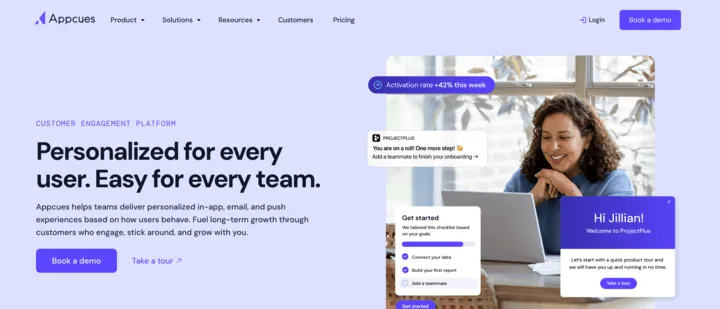
What sets Appcues apart on this list is reach past the app itself. On top of the usual in-app flows, checklists, and tooltips, it runs behavioral email and push, so you can nudge a user who has drifted away, not only the ones currently logged in.
Pricing. Quote-based across its Start, Grow, and Enterprise tiers, with the full feature set on every plan. Vendr’s median contract sits near $15,000/year. Free trial available.
What it does well. Running in-app messages, email, and push from one system lets a single campaign catch a user in the product and follow up in their inbox. Because features aren’t tiered, the entry plan isn’t a stripped version of the product. Its mobile SDKs also place guides inside native iOS and Android apps, not just the browser.
Where it falls short. Past the entry tier it runs pricier than the tools that publish their rates. And it’s firmly customer-facing, with no way to layer guidance onto the internal enterprise apps Whatfix specializes in, or to run the governed, compliance-heavy rollouts Whatfix handles for regulated industries.
Best for. SaaS teams that want to reach and re-engage their own users across in-app, email, and push.
Chameleon: highly customizable in-app experiences
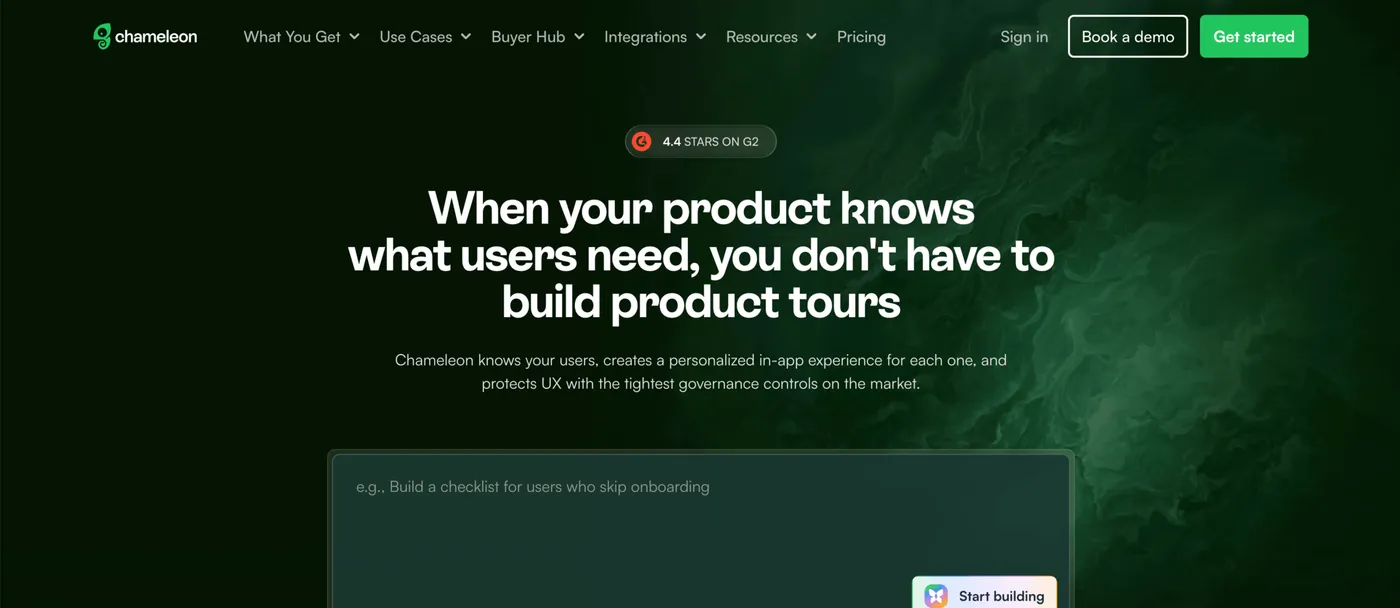
Chameleon’s angle is control: it’s built so in-app experiences match your product’s look and don’t degrade into a pile of overlapping popups, which matters once several people are shipping messages at once.
Pricing. From $279/month. Free trial available.
What it does well. Styling controls let messages read as a native part of the UI. The governance layer is where it separates from the pack: cap how often any one user is interrupted, get notified when an experience stops converting, and hold changes behind admin approval before they reach users. A/B testing settles what actually performs.
Where it falls short. The $279 Startup plan caps you at 10 live experiences. Custom styling and A/B testing start on Pro at $750 a month, and unlimited experiences on Growth at $1,750 a month.
Best for. SaaS teams that care about on-brand, well-governed in-app experiences and expect to grow into the Growth tier.
Userflow: no-code onboarding with a built-in AI assistant
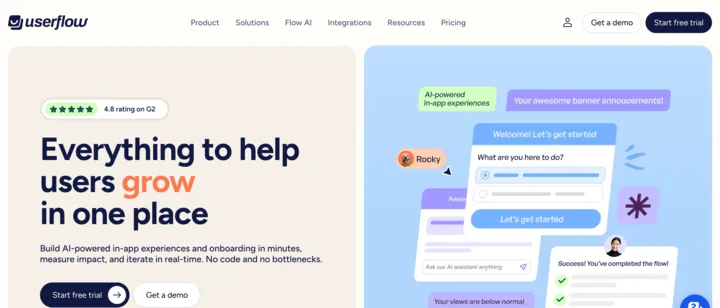
Userflow has a reputation as the quickest of these tools to build in, and it pairs that speed with an in-app AI assistant that fields users’ questions directly.
Pricing. From $240/month for 1,000 monthly active users. Free trial available.
What it does well. Non-technical teams get productive fast, and reviewers keep returning to how quickly they can ship. Support has a strong reputation. It’s also one of the few here to offer both AI flow generation and a user-facing chatbot.
Where it falls short. The user-facing chatbot needs the $400/month Studio plan. Reporting is thin, with no funnels, retention, or paths. And it works on the web only.
Best for. SaaS teams after fast, simple onboarding with an AI assistant pointed at their users.
Pendo: product analytics and adoption, for users and employees
Pendo is the entry that refuses to sit on one side of the line. Its foundation is product analytics, but it also ships in-app guides and a separate employee-facing DAP, which makes it a real option whether the people you’re guiding are customers or staff.
Pricing. A free tier covers up to 500 monthly active users with analytics, guides, and basic surveys. Paid plans are custom; Vendr’s median lands around $48,500/year. Free trial available.
What it does well. No tool here goes deeper on analytics: funnels, retention, paths, and session replay, plus surveys and churn scoring. Its retroactive tracking captures history from install day, so you can investigate behavior you never thought to instrument. Mobile SDKs cover iOS and Android, and unlike Whatfix there’s a real free tier to start on.
Where it falls short. That breadth is heavy: it costs a lot at scale, and each module is its own configuration project. For the specific enterprise task of driving adoption across a big stack of internal apps with structured, compliance-grade training, Whatfix and WalkMe are the more specialized choices.
Best for. Teams that want serious analytics alongside in-app guidance and are guiding customers at least as much as employees.
Apty: process compliance and clean data entry across workflows
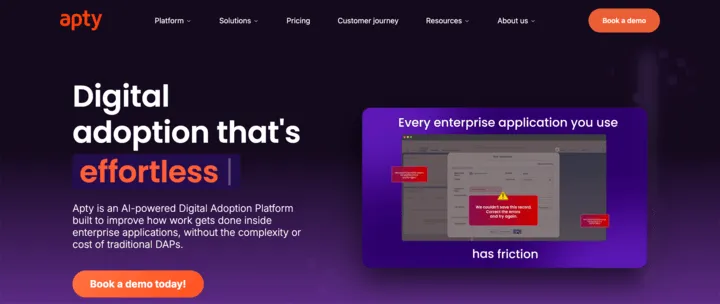
On paper Apty is a direct Whatfix competitor, an enterprise DAP for internal software, but it plays a narrower game: it leans hard on getting a process done the same way every time and keeping the data employees enter accurate.
Pricing. Quote-based, with no public price. Vendr’s data averages around $45,000/year (roughly $26,000 to $78,000), and single-application deals start near $9,500/year. No free tier.
What it does well. Enforcement is the pitch. Apty can check data against rules at the moment of entry, head off the process mistakes that create downstream cleanup, and steer employees through tasks that cross several systems. It reviews well, holding the top of G2’s DAP satisfaction rankings for a run of quarters, and it stands up faster than the most implementation-heavy platforms.
Where it falls short. Reporting is thin, mostly guide-engagement numbers rather than funnels or cohorts, where Whatfix’s bundled analytics goes further. Apty is also a smaller player than Whatfix, so there are fewer integrations, partners, and community resources to lean on during a rollout. And it has nothing like Whatfix’s Mirror sandbox for rehearsing a workflow.
Best for. Operations-heavy enterprises whose top priority is consistent execution and clean data in systems like Salesforce and Workday.
Userlane: enterprise adoption, faster to roll out than Whatfix
Userlane chases the same enterprise buyer as Whatfix, the IT and L&D teams rolling out third-party software such as SAP and Microsoft 365, and makes speed of deployment its main argument.
Pricing. Quote-based. Across the deals Vendr has recorded, the average is about $18,000/year, the most affordable of the enterprise DAPs here, scaling with users and applications.
What it does well. Alongside a faster rollout than the heavier platforms, Userlane adds a discovery layer: it tracks which applications employees actually open, scores how well each is adopted, and surfaces licenses nobody uses, so the same tool that lifts adoption can trim software spend. Its focus skews to regulated sectors.
Where it falls short. It doesn’t match WalkMe’s depth on cross-application automation, and its partner network is smaller. There’s no Mirror-style rehearsal sandbox. And as an employee-facing platform, it isn’t the tool for onboarding your own customers.
Best for. Enterprises that want DAP capabilities without a drawn-out implementation, and that value seeing real usage and wasted licenses.
WalkMe: Whatfix’s closest match, the enterprise heavyweight
WalkMe is the platform Whatfix is most often weighed against, the other full-scale enterprise DAP, designed to sit over a whole portfolio of internal apps and guide employees through any of them from one place. SAP’s 2024 acquisition now has it positioned as the connective layer for enterprise AI.
Pricing. No public pricing. Vendr’s median is about $40,000/year, with real contracts running from roughly $14,000 to north of $200,000, and implementation billed on top. No free tier or trial.
What it does well. A single deployment can guide staff across many systems at once, with one task moving through Salesforce, a pricing tool, and a contract app without leaving WalkMe’s guidance. It’s the deepest in the category on cross-application automation and carries the largest partner ecosystem, across desktop, mobile, and web.
Where it falls short. It’s the most demanding to implement, typically pulling in consultants or integrators, and because its guidance sits over other apps, changes underneath can break it. Add-ons like Insights, Mobile, and ActionBot are billed separately, and AI usage becomes its own line item in 2027. It also lacks a Mirror-equivalent practice sandbox.
Best for. Large organizations rolling internal software out to thousands of employees who want one platform covering many apps at once.
When Whatfix is the right pick
Weighing alternatives doesn’t rule Whatfix out. It’s the right call when the job is getting a large workforce productive on internal software, and particularly when people need to practice a process before doing it live.
The feature that sets Whatfix apart is Mirror. It captures an application screen by screen as someone works through a real task, then rebuilds that capture as a safe sandbox where employees rehearse, and where you catch mistakes, before anyone touches the production system. In banking, healthcare, or insurance, where a wrong click in the live system carries real cost, nothing else here does the same thing. On top of that, Whatfix folds in product analytics, handles desktop and virtual-desktop environments like Citrix, and supports large, governed walkthrough programs spanning many applications.
Where it’s the wrong fit: onboarding your own customers into your SaaS product, or any team wanting something light and inexpensive, because Whatfix is an enterprise purchase, with the multi-month setup and learning curve that implies.
How to choose between them
Answer one question before you look at a single feature: are the people you’re guiding your customers or your employees?
- Employees using internal software (Salesforce, Workday, SAP): you’re shopping for a DAP, which points to Apty, Userlane, or WalkMe alongside Whatfix.
- Customers using the product you sell: you want a product adoption tool, which means FlowNavi, Userpilot, Appcues, Chameleon, or Userflow.
- Genuinely both: Pendo is the one platform here that serves each.
After that, match the tool to whatever sent you looking:
- A complete toolkit at a low, predictable price: FlowNavi
- Product adoption with real analytics attached: Userpilot or Pendo
- Reaching users by in-app, email, and push together: Appcues
- On-brand, tightly governed in-app messages: Chameleon
- The fastest setup, with a user-facing AI assistant: Userflow
- Strict process and clean data entry: Apty
- A lighter, quicker-to-deploy enterprise DAP: Userlane
- The widest cross-app reach at enterprise scale: WalkMe
Keep one economic fact in view: these two groups price on different planets. Product adoption tools mostly post their rates and begin in the low hundreds per month; the enterprise DAPs, Whatfix among them, quote custom deals in the tens of thousands per year. If price is part of what’s pushing you away from Whatfix and your actual need is customer onboarding, that difference works in your favor.
Summary
| Tool | Built for | Starting price | Key strength |
|---|---|---|---|
| Whatfix | Employees (internal software) | Custom (~$32k/yr) | Practice sandbox before the live system |
| FlowNavi | Your users | $79/mo | Whole toolkit, no feature gating |
| Userpilot | Your users | $299/mo | Adoption and analytics together |
| Appcues | Your users | Custom (~$15k/yr) | In-app, email, and push in one |
| Chameleon | Your users | $279/mo | On-brand messages with governance |
| Userflow | Your users | $240/mo | Fast build, user-facing AI |
| Pendo | Users + employees | Free + custom (~$48.5k/yr) | Deepest analytics, native mobile |
| Apty | Employees | Custom (~$45k/yr) | Enforced process and data accuracy |
| Userlane | Employees | Custom (~$18k/yr) | Fast rollout, usage and license insight |
| WalkMe | Employees | Custom (~$40k/yr) | Broadest cross-app reach |
FAQ
How much does Whatfix cost?
Whatfix keeps its pricing private and quotes every deal individually. Vendr’s contract data averages about $32,000/year, with the entry-level Standard plan reported north of $24,000/year and large, multi-application rollouts topping $100,000. What you pay tracks the number of users, the apps you cover, and the features you switch on. There’s no free tier, but a free trial is offered.
Is Whatfix for customer onboarding or employee onboarding?
Mostly employee onboarding. Whatfix is an enterprise digital adoption platform for making staff productive on internal systems like Salesforce, Workday, and SAP, and it’s especially common in regulated industries. It can be pointed at customers, but its design and pricing assume the enterprise, employee-facing use case. If your aim is onboarding the customers of your own SaaS product, a product adoption tool like FlowNavi, Userpilot, Appcues, Chameleon, or Userflow is the closer fit.
What’s the best Whatfix alternative?
There isn’t one answer; it turns on your use case. To drive employee adoption of internal software, WalkMe is the nearest equivalent, Userlane the lighter and faster option, and Apty the pick for process- and compliance-heavy teams. If you’re really onboarding customers, FlowNavi, Userpilot, Appcues, Chameleon, and Userflow suit better and cost far less. Pendo can go either way.
Can I use a product adoption tool for employee onboarding, or the other way around?
In principle yes, since both rely on the same primitives, tours, tooltips, and checklists, which is why they keep turning up in the same searches. But they diverge on focus and economics. DAPs charge per employee seat and often per application, lay guidance over software you don’t control, and can enforce data rules across multi-system processes. Product adoption tools bill on monthly active users, embed in your own product, and stop at guiding rather than enforcing. Cross the line and you tend to either overpay or run into something the tool simply can’t do.
Is there a free Whatfix alternative?
Whatfix itself has no free tier. Of the alternatives, Pendo offers one for up to 500 monthly active users (analytics, guides, basic surveys), while FlowNavi and several others run free trials. If you have engineering time, open-source tour libraries such as Intro.js, Shepherd.js, and Driver.js cost nothing, though your team owns the targeting, analytics, and upkeep.
Which of these can run guides inside an iOS or Android app?
That takes mobile SDKs rather than a web snippet. Among the alternatives here, Pendo, Appcues, WalkMe, and Userpilot (as a paid add-on) ship mobile SDKs and can place guides inside native iOS and Android apps. FlowNavi, Chameleon, and Userflow are web-focused, so they cover the browser but not a downloaded app.